
CSA WEEKLY BOX INFO
Week of September 8th
-
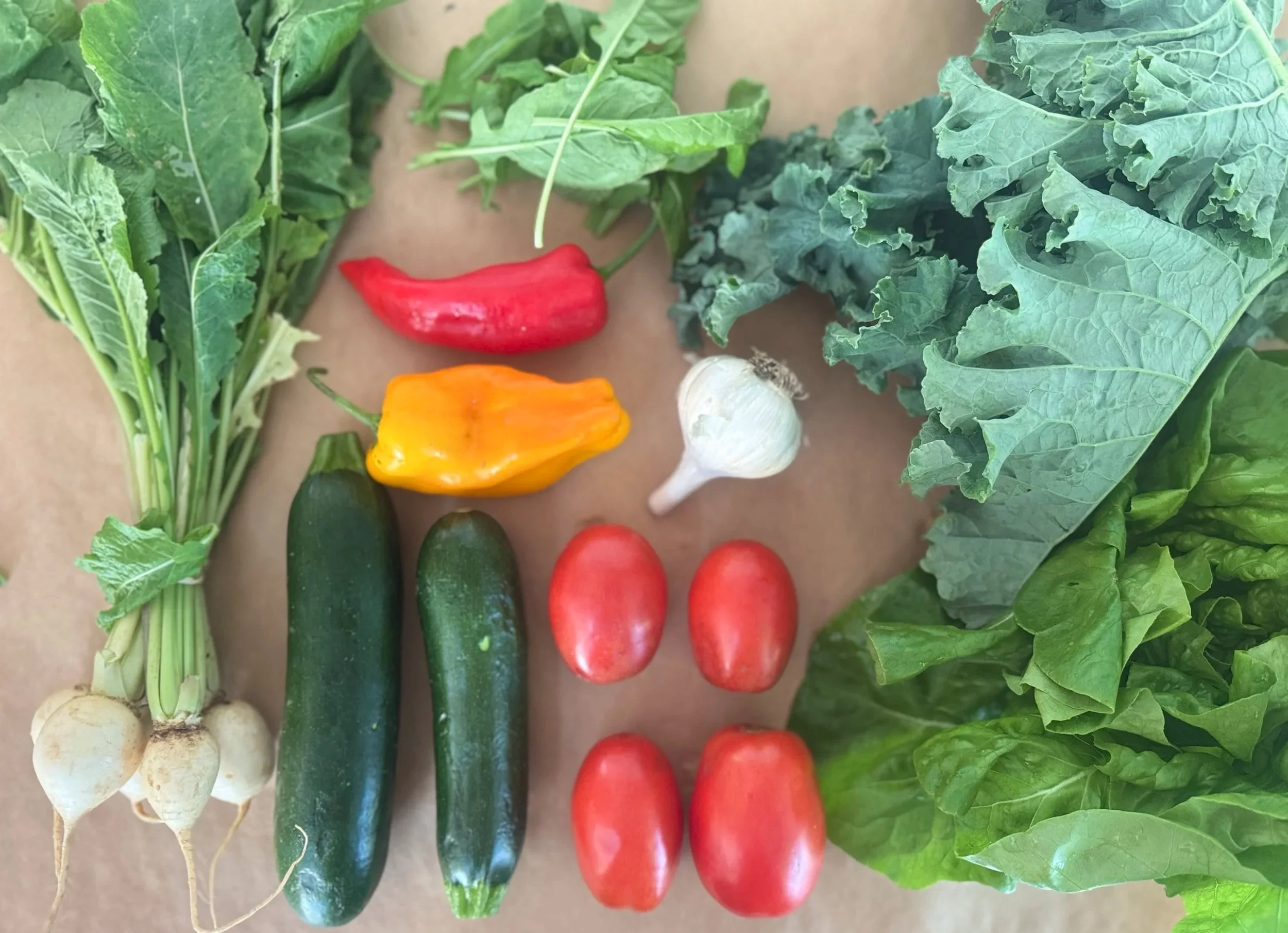
Small Share:
garlic, sauce bundle, baby greens, kale, sauce tomatoes, pepper medley
Large Share:
garlic, sauce bundle, baby greens, lettuce, kale, sauce tomatoes, pepper medley, zucchini, hakurei turnips
-
This savory recipe, made with delicate phyllo dough, uses fresh zucchini, and your favorite seasonal vegetables. It's the perfect dish for brunch on a slow Sunday morning.
It’s ratatouille season! Ratatouille is a classic end-of-summer French stew that’s fun to make. It’s packed with fresh produce: tomatoes, eggplant, zucchini and yellow squash, and bell pepper.
Quick & satisfying, make these chips for movie night, game night, when you’re hosting friends, or just need a snack.
-
Hakurei turnips, a Japanese salad turnip, are crunchy and sweet. They’re great as crudité or in a salad. Try them caramelized in a hot pan or the oven with a drizzle of sesame oil or butter. Don’t forget to cook the greens!
-
Root vegetables are a great way to add color and texture to your salads, are delicious roasted together as a medley, and contain a wide range of nutrients. For example, one serving of carrots provides over 200% of your daily recommended consumption of vitamin A, while beets are high in potassium, and turnips and rutabagas are high in vitamin C and magnesium. Radishes and turnips only take 21 days to grow and are ready early in the spring through late fall. Carrots and beets take weeks or months longer to mature and are available between July and November.
Storage: Remove the green tops from the root vegetables to prevent them from drawing moisture from the roots. Keep the roots washed and in an open container with a moist towel on top for up to two weeks. Store the greens separately, as you would a cooking green (in a perforated plastic bag with a damp paper towel in the fridge), and they will last up to 5 days.
-
Hello from the fields,
What a sigh of relief we let out today! The farm crew has an extra day off this for the unofficial east end holiday of Tumbleweed Tuesday, and they deserve it! This dedicated team works so hard, as does our entire staff at Amber Waves, to grow your food and keep the farm looking its best for the community to enjoy. Today, they rest, and then we’ll be back to work thinking about fall and the arrival of squash and sweet potatoes. Happily, we’ll still continue to enjoy tomatoes and our favorite summer staples for many weeks to come. We hope you can take advantage of this week’s beautiful weather as we settle into a slower pace and the quieter part of the season out east.
Amanda + Katie + The Amber Waves Team
Week of September 1st
-
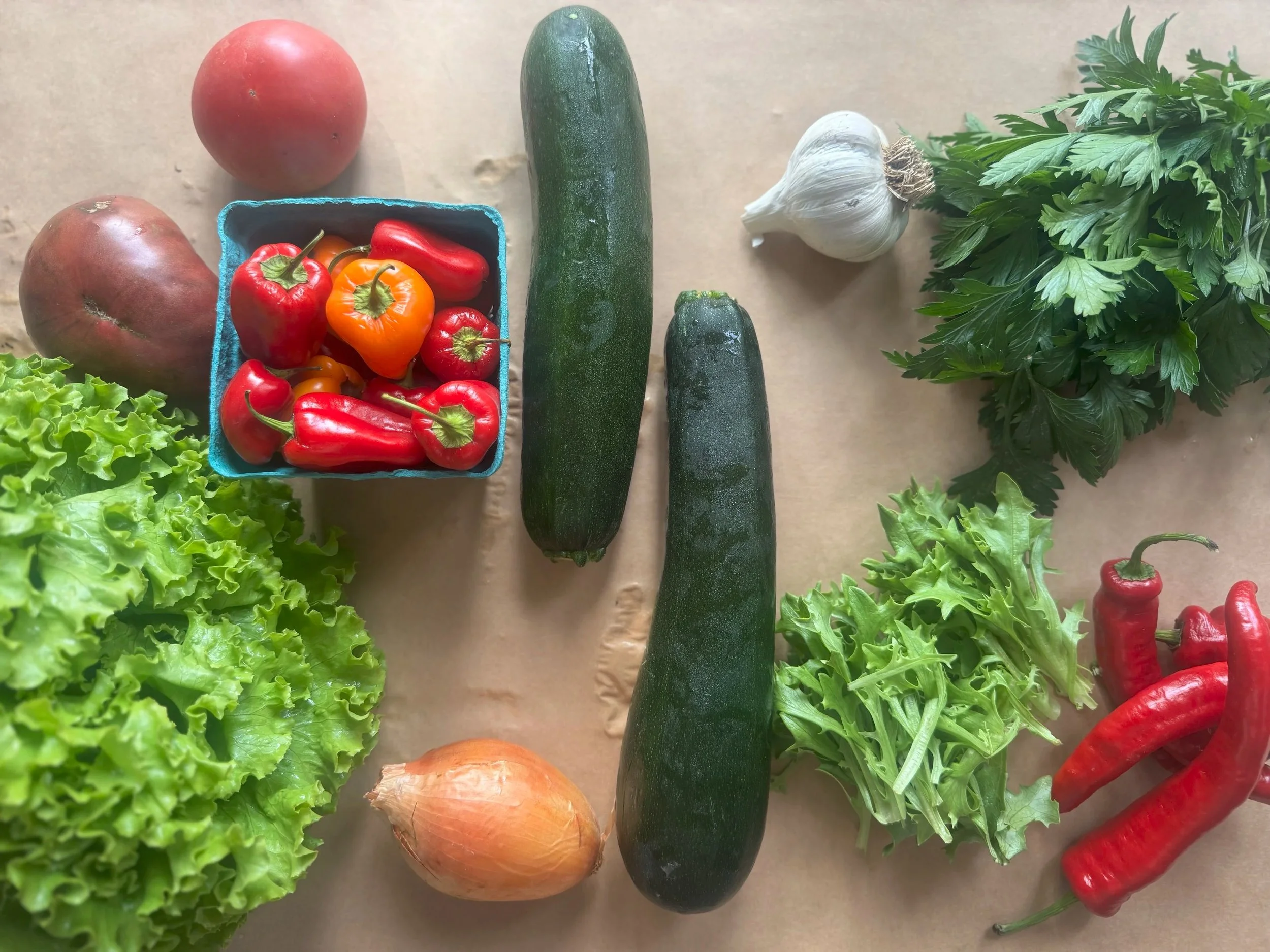
Small Share:
garlic, parsley, baby greens, lettuce, italian eggplant, beefsteak and heirloom tomatoes, lunchbox peppers
Large Share:
garlic, onions, parsley, baby greens, lettuce, jimmy nardello peppers, cucumbers, beefsteak and heirloom tomatoes, lunchbox peppers
-
A fun and retro-feeling hors d'oeuvre utilizing your lunchbox peppers.
Simple and easy to customize, this is a quick meal that incorporates any seasonal produce.
This recipe incorporates olive oil into a traditional gremolata creating a sauce that brightens up any dish.
-
An excellent pepper for snacking, lunchbox peppers are very sweet and crunchy. Although you can eat them green, we recommend waiting until the peppers have ripened to yellow, orange, or red. Avoid pulling the plant from the ground by always using two hands to harvest - one to hold the plant and the other to pull the pepper.
-
Not quite a tomato, but in the same plant family (the nightshade or solanaceous family), tomatillos are especially popular in Mexico and Central America. They are the primary ingredient in the mild “salsa verde.” The fruits enclosed in an inedible papery husk can be chopped and added to fresh salsa and pico de gallo for a tangy flair or roasted and pureed with garlic, salt and pepper to make outstanding salsa verde.
-
Hello from the fields,
Yesterday I learned of the passing of Wendell Berry, who at 92 spent a lifetime as a poet, farmer, writer, and advocate of sustainable agriculture while living humbly in his native Kentucky. It was a dream of mine to see him speak in person, and while that never came to pass I have such gratitude for his powerful body of work, which inspired me, as a young college student in the early 2000s, to want to make the world a better place. I didn’t know it at the time, but the emphasis his writing made on the importance of agriculture in America was driving me towards what has ended up being my life’s work at Amber Waves. Included below is a fitting excerpt of The Pleasures of Eating from his book titled What are People For? (You can find The Pleasures of Eating in full here).
Many times, after I have finished a lecture on the decline of American farming and rural life, someone in the audience has asked, "What can city people do?"
"Eat responsibly," I have usually answered. Of course, I have tried to explain what I mean by that, but afterwards I have invariably felt there was more to be said than I had been able to say. Now I would like to attempt a better explanation.
I begin with the proposition that eating is an agricultural act. Eating ends the annual drama of the food economy that begins with planting and birth. Most eaters, however, are no longer aware that this is true. They think of food as an agricultural product, perhaps, but they do not think of themselves as participants in agriculture. They think of themselves as "consumers." If they think beyond that, they recognize that they are passive consumers. They buy what they want — or what they have been persuaded to want — within the limits of what they can get. They pay, mostly without protest, what they are charged. And they mostly ignore certain critical questions about the quality and the cost of what they are sold: How fresh is it? How pure or clean is it, how free of dangerous chemicals? How far was it transported, and what did transportation add to the cost? How much did manufacturing or packaging or advertising add to the cost? When the food product has been manufactured or "processed" or "precooked," how has that affected its quality or price or nutritional value?
Most urban shoppers would tell you that food is produced on farms. But most of them do not know what farms, or what kinds of farms, or where the farms are, or what knowledge of skills are involved in farming. They apparently have little doubt that farms will continue to produce, but they do not know how or over what obstacles. For them, then, food is pretty much an abstract idea — something they do not know or imagine — until it appears on the grocery shelf or on the table.
…………………………………..
The pleasure of eating should be an extensive pleasure, not that of the mere gourmet. People who know the garden in which their vegetables have grown and know that the garden is healthy and remember the beauty of the growing plants, perhaps in the dewy first light of morning when gardens are at their best. Such a memory involves itself with the food and is one of the pleasures of eating. The knowledge of the good health of the garden relieves and frees and comforts the eater. The same goes for eating meat. The thought of the good pasture and of the calf contentedly grazing flavors the steak. Some, I know, will think of it as bloodthirsty or worse to eat a fellow creature you have known all its life. On the contrary, I think it means that you eat with understanding and with gratitude. A significant part of the pleasure of eating is in one's accurate consciousness of the lives and the world from which food comes. The pleasure of eating, then, may be the best available standard of our health. And this pleasure, I think, is pretty fully available to the urban consumer who will make the necessary effort.
I mentioned earlier the politics, esthetics, and ethics of food. But to speak of the pleasure of eating is to go beyond those categories. Eating with the fullest pleasure — pleasure, that is, that does not depend on ignorance — is perhaps the profoundest enactment of our connection with the world. In this pleasure we experience and celebrate our dependence and our gratitude, for we are living from mystery, from creatures we did not make and powers we cannot comprehend. When I think of the meaning of food, I always remember these lines by the poet William Carlos Williams, which seem to me merely honest:
There is nothing to eat,seek it where you will,but the body of the Lord.The blessed plantsand the sea, yield itto the imagination intact.
1989
But YOU! As a Community Supported Agriculture member YOU know your food, you know your farmer, you’ve made the honorable choice to invest in your health and mine, in the pleasure of flavor, in the future of small farms across the country. As many of you depart for the season after Labor Day, the entire team here at Amber Waves extends a deeply heartfelt THANK YOU to each of you, for voting with your dollars, choosing local agriculture, and making our farm possible. And if you’re about to pass through the Amber Waves gates for the last time this season, remember that there are other farms waiting for you at your local farmers market that would love to feed you all fall and winter. We can’t wait for your return next season, we hope you come hungry.
For those of you who we get to keep on the farm a little longer, through Indigenous People’s Day or even the frigid weeks leading up to Thanksgiving, we are so excited to share the bounty of the fall harvests that are coming our way. We hope you are hungry, too!
With Gratitude,
Amanda + Katie + The Amber Waves Team
Week of August 25th
-
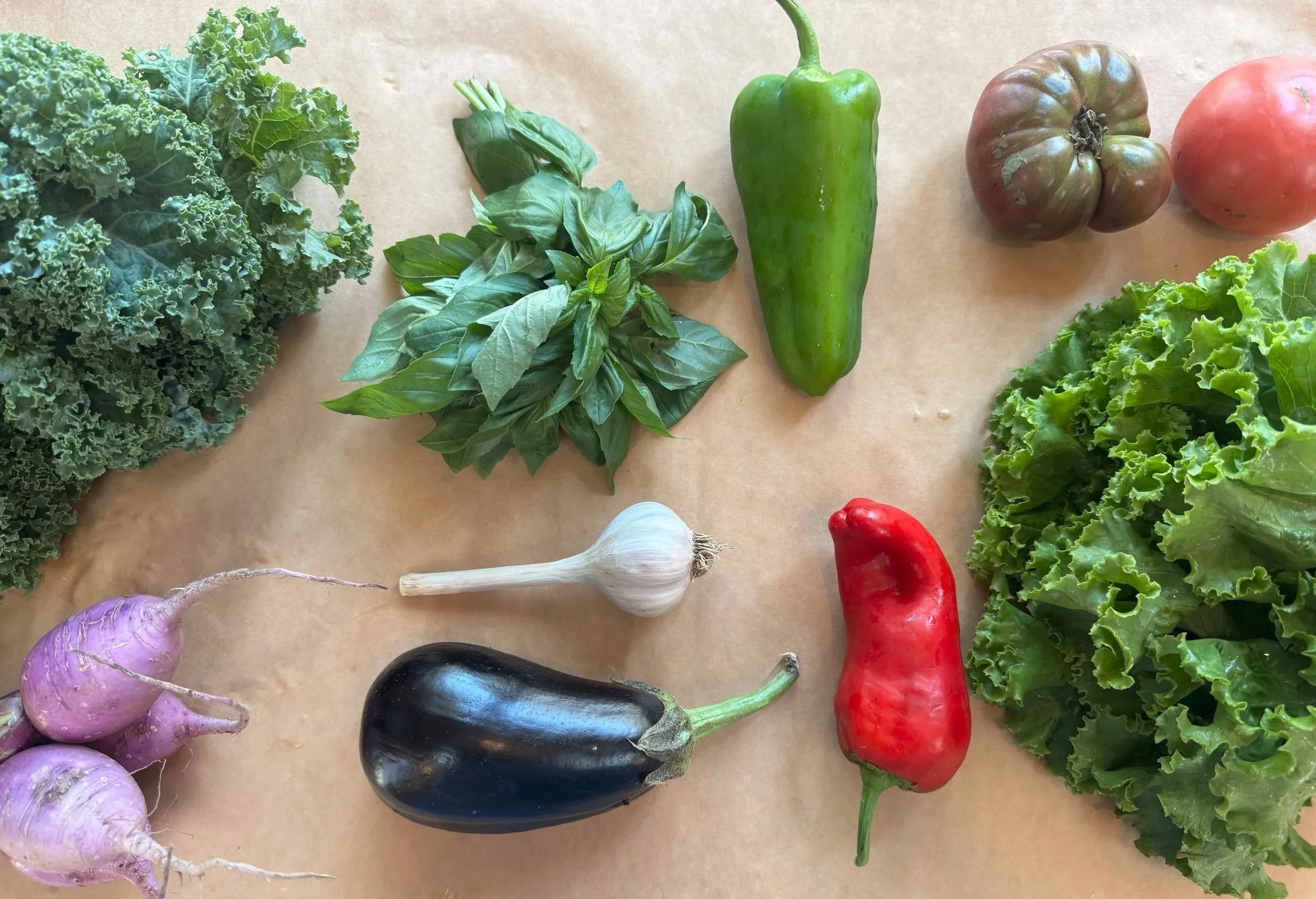
Small Share:
garlic, basil, arugula, lettuce, kale, beefsteak and heirloom tomatoes, pepper medley
Large Share:
garlic, basil, salanova, lettuce, kale, beefsteak and heirloom tomatoes, pepper medley, eggplant, daikon radish
-
Great to bring to the beach or on a picnic, this sandwich is summer perfection.
A plant based dinner utilizing our fresh peppers this week!
A great spread for sandwiches and burgers, or dipping sauce for fries.
-
We grow a few different salad green mixes at the farm! Each mix has a variety of colors, flavors, and textures to add to a salad. Our signature “spicy salad” mix is a mixture of Asian greens, such as mizuna and bok choy, along with burgundy mustards that give the mix a flavorful, spicy bite! Our other mixes aim to please with different varieties of greens, colors, textures and flavors
-
Heirloom’ indicates an open-pollinated variety (saved seed produces identical offspring to the parent plant) that has existed since before 1942. Unlike hybrid crops, heirlooms have not been bred for productivity or long shelf life. They have been kept and passed around farming and gardening communities because of their exceptional taste and beauty. Heirlooms’ flavor is best appreciated when sliced and eaten raw with a sprinkle of salt and a drizzle of olive oil. Heirlooms produce a beautiful sauce with a deeply complex and unique flavor when cooked. (An important note: hybrid does not mean genetically modified/GMO.) A hybrid variety is a cross-pollination of two different varieties, producing a 27 seed that has the genetic material of both. We grow many hybrid varieties. We do not grow GMO varieties.
-
When Amanda and Katie first dreamed up Amber Waves, they imagined an East End farm that grew all the ingredients to make pizza: from the whole wheat for the crust, to the tomatoes, herbs, and fresh veggies to top it off. For that reason, the pizza oven has become the centerpiece of Amber Waves events over the years, and many of you have enjoyed a hot pizza made by Amanda (and her young assistants) at our CSA potlucks and pizza parties.
This week’s box is the embodiment of that dream, bringing you fresh tomatoes, garlic, peppers, and basil in your box, and pizza flour and mozzarella cheese as optional add-ons. With your box in hand, you can enjoy your own homemade pizzas, just as my family of five does every Friday night. In our house, the kids usually opt for plain cheese, pepperoni, or meatballs, while my husband and I top our pizzas with heirloom tomatoes, onions, peppers, basil, and fresh arugula. And of course, either fresh pesto, Amber Waves tomato sauce, or homemade sauce from farm tomatoes we preserve this time of year. Over the years, Pizza Friday has become as much a part of our family’s traditions as it is a part of Amber Waves’ history–here’s hoping this tradition brings as much joy to your family as it does to mine.
—Jess
Week of August 18th
-
Small Share:
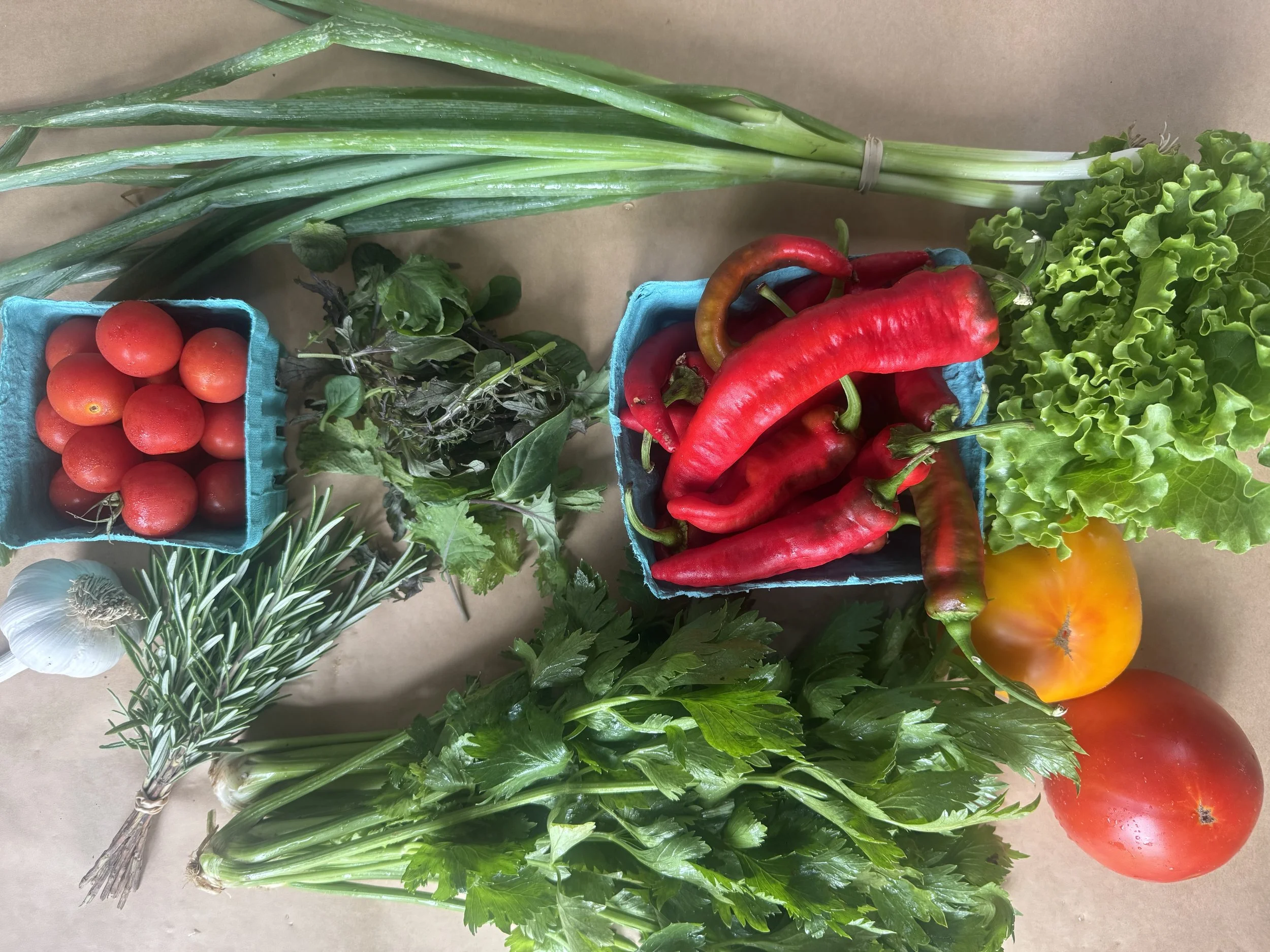
garlic, rosemary, spicy mix, tomatoes, cherry tomatoes, celery
Large Share:
garlic, scallions, rosemary, spicy mix, lettuce, jimmy nardello peppers, tomatoes, cherry tomatoes, celery
-
Grilled, Marinated Jimmy Nardello Peppers
Grill until charred, then toss with vinegar, olive oil, garlic and herbs.
Roasted Eggplant with Rosemary
Perfect for summer grilling with fresh rosemary
15 minutes + 6 ingredients = perfect summer meal
-
Compared to celery from the supermarket, our celery is much more flavorful and is best used as a base for stock or soup. You can also use the leaves as an herb. It is delicious mixed with parsley.
-
Fresh, ripe tomatoes are a summer staple (July-October) and are full of flavor and the cancer-fighting antioxidant lycopene. There are more than 10,000 tomato varieties worldwide and this year, Amber Waves is growing over 60 varieties! Tomatoes are one of the more labor-intensive crops on our farm, requiring trellising, pruning, and up to 100 days to mature.
Storage: Store beefsteak, heirloom, and plum tomatoes at room temperature or only slightly chilled but not cold (above 50 degrees to maintain good flavor and texture). Store them in a single layer, upside down; the shoulders are the strongest part of the tomato and will last longer that way! Expect tomatoes to last up to a week, depending on their ripeness. For maximum flavor, store cherry tomatoes outside of the fridge.
-
Hi from the fields,
One of my favorite parts of this job is sitting down each week to determine what is going into your box. Each Friday field managers Sara and Jess populate an availability spreadsheet to plan for the following week, making note of what we have in each field and in what quantities: enough for the market, enough for the kitchen, enough for the CSA (small, large, optional only?), enough for wholesale, etc. It is an incredibly challenging puzzle to solve every week dependent on so many variables outside of our control – imperfect germination in a baby greens rounds might mean we only have enough for one size share when Jess was planning for it to be in both, unexpected weather events (of which we’ve had many this season) might push back a planting of lettuce by six days leaving a gap in availability for all of our outlets. I rely on their notes to draft your boxes every Saturday and then it goes back and forth between all of us a few times before I finalize the box Sunday night in advance of Monday morning’s harvest. We use a rough formula to guide each box – including a cooking green as well as a salad green, an allium, a fresh herb bunch, etc – and then try to mix it up with new exciting crops as they come in. This week you are getting one of my favorite crops that we grow and a real passion project of mine: celery!
No crop better embodies the high effort/high reward aspect of organic farming – the celery you’ll eat this week has gone through a yearslong process of trial and error to make it into your box. Celery is extremely finicky: the seeds need light to germinate so they have to be delicately (and regularly) misted their entire life in the greenhouse. If cared for properly, they take 3 weeks to germinate and even longer to establish viable roots before they can be transplanted. Once they’re in the ground they take 90 days to reach maturity, IF they don’t succumb to disease. We lost the bulk of last year’s crop to soil-borne disease so we are trialing two new varieties this year that have better disease resistance. The celery we harvested for you this week was seeded the first week of March when there was still snow on the ground and we’ve lovingly tended to it in the field all season long. It feels like a real victory that we have enough celery for 336 shares this week, proof that each year we’re getting a little better at it. We put in all of this work and all of this thought because it is worth it: once you eat our celery you’ll never look at grocery store stuff the same – it’s like watching a movie in technicolor vs. black and white. I hope you love it as much as I do!
Happy crunching,
Amelia
PS to keep your stalks fresh and crunchy you can cut off the top leaves and submerge the core into a jar of cold water, it’ll keep like this in the fridge for a few weeks if you swap out the water occasionally
Week of August 11th
-
Small Share:
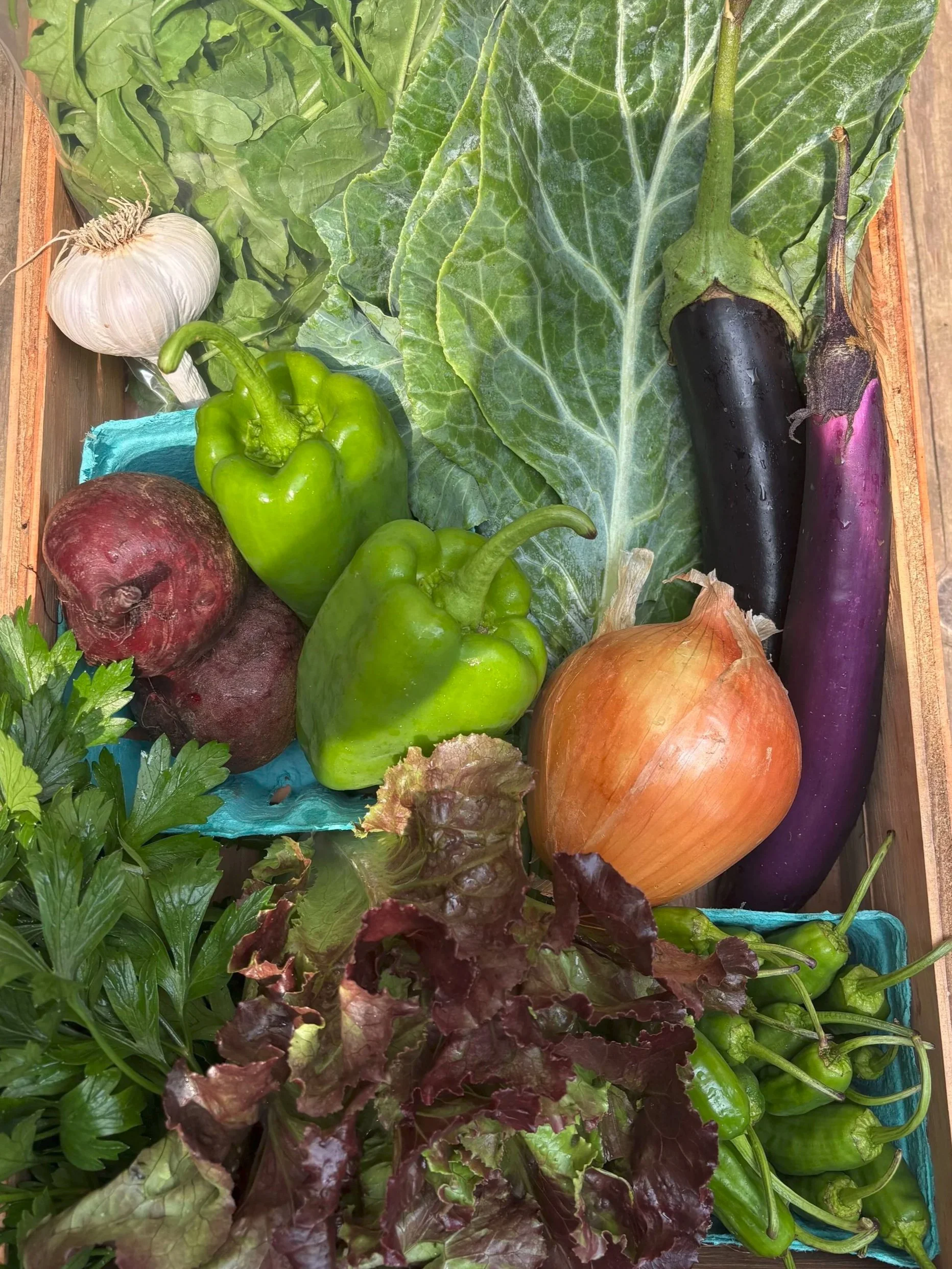
Garlic, onion , parsley, red Russian kale, green peppers, Japanese eggplant, shishitos, beets
Large Share:
Garlic, onion , parsley, collards, lettuce, arugula, green peppers, Japanese eggplant, shishitos, beets
-
Roasted beets, peppary arugula and crunchy marcona almonds- this salad should not be missed.
Inspired by a CSA member’s suggestion of their favorite use of collards. Customize however you’d like.
Foraging not required this week! Enjoy this very short seasoned fruit in the most summer preparation! A compote recipe is also included!
-
Sweet peppers include bell peppers and Cubanelles, which are both delicious raw or cooked. Bell peppers are the classic pepper - crunchy and juicy. All peppers start green (or purple) and have an earthier and more bitter flavor when harvested green. Depending on the variety, green peppers turn several colors when left to ripen on the plant for several weeks, significantly increasing their sweetness. Cubanelle peppers come in all colors but start green before ripening to yellow, orange, or red. Also called Italian frying peppers, they have thinner skin and less water than a bell pepper. Our favorite peppers for snacking are the colorful mini Lunchbox peppers.
-
The leafy herbs grown in the herb garden and our fields are available between late spring and fall. Some herbs, like basil and cilantro, are more challenging to grow in summer due to disease and heat intolerance. Leafy herbs are flavorful and can transform a dish by providing freshness and vibrant green color
-
Hello from the CSA room!
It has been such a pleasure getting to know all of you. As a former CSA member myself (I split a share with my mom back in 2017), I had only a small sense of how special this community was. That became even more apparent when I started working at the farm three years ago but being fully immersed in the program and having the pleasure of interacting with so many of you each week has given me a whole new appreciation.
We still have a solid 3 weeks of peak membership left so I won't get too sappy yet but we hope you'll join us on Thursday, 5-7pm for our annual Wine and Cheese Happy Hour beyond the gates. It is sure to be a memorable evening with a fantastic backdrop.
Hope to see you in the fields or at pick up soon!
Hana & CSA Team (Bill, Jane, Lauren, Pam & Cynthia)
Week of August 4th
-
Small Share:
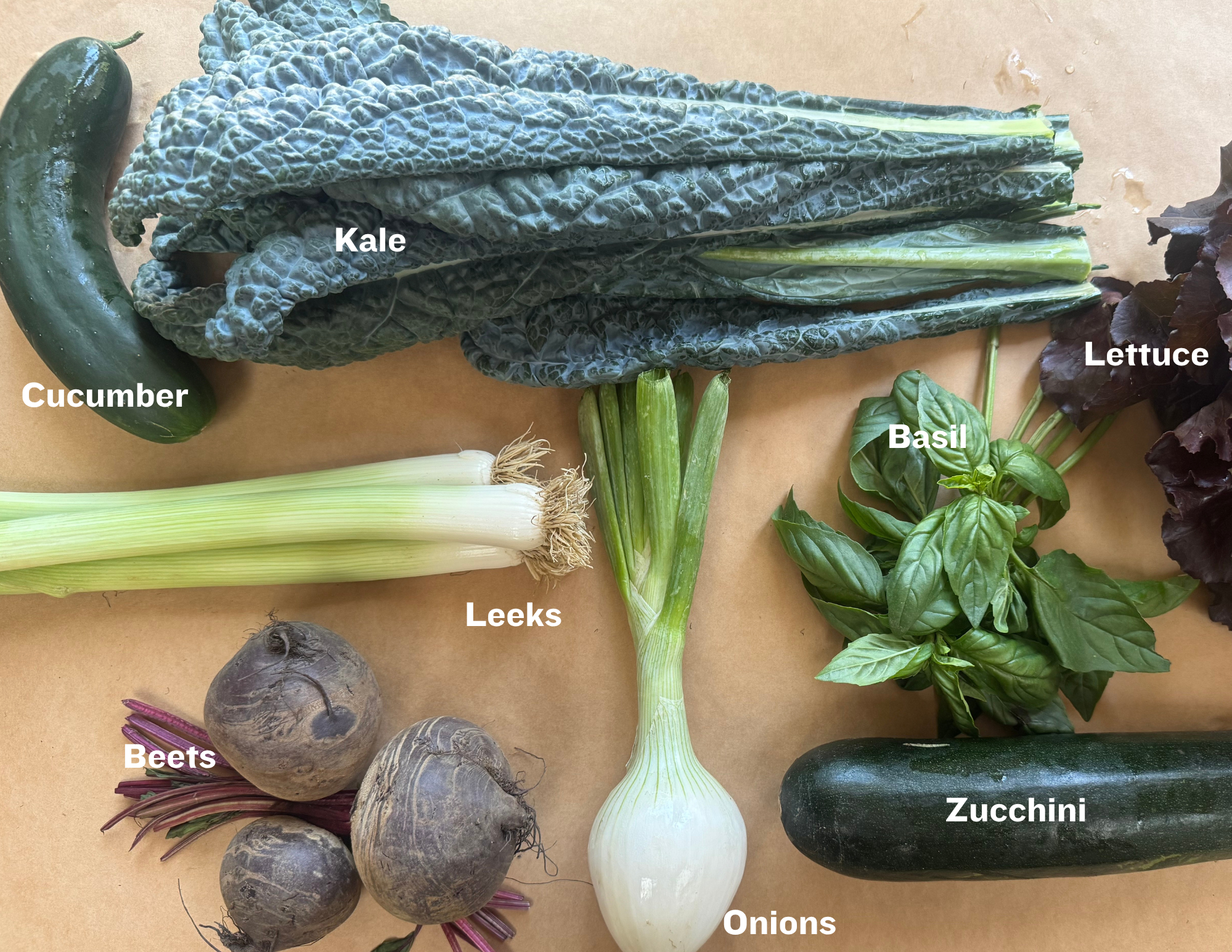
Garlic, basil, baby greens, eggplant, cucumbers, cherry tomatoes, balsam corn
Large Share:
Garlic, onions, basil, kale, baby greens, eggplant, cucumbers, cherry tomatoes, balsam corn
-
Fresh, bright, lightly creamy & spicy, it's easy to make and sure to please.
This simple, crowd-pleasing dip is packed with smoky flavor and is perfect for summer entertaining.
Linguini with burst cherry tomatoes and chilis
A simple pasta that showcases the first sweet cherry tomatoes of the season. Bursting with fresh flavor and a touch of chili heat, it's the perfect way to celebrate summer.
-
Eggplants take about 60 days to mature, and like the summer heat, their season runs between July and November. They are rich in nutrients, including copper and manganese. We love eggplants in the summer, especially on top of pizza or in ratatouille
Storage: Whole eggplants can be stored for many days in a cool, dry place, not in the
refrigerator.
● Italian: We grow a variety of eggplants, including the classic Italian heirloom Black Beauty and the stunning purple and white Italian variety Nubia. Char these eggplants on the grill, stove, or oven and blend with tahini and garlic for baba ganoush!
● Sicilian: Sicilian eggplants are rounder in shape than the classic Italian eggplant and come
in different shades of violet. The skin is a little thinner and less bitter than other varieties and their round shape makes them perfect for some cheesy eggplant parm!
● Japanese: Japanese eggplants are hands-down our favorite. They have thinner skin than Italian eggplants and creamy flesh. We love them cut in half and grilled with olive oil and salt.
● Mini: Our favorite miniature eggplant is Fairytale, with delicate purple and white stripes. We love this eggplant grilled whole or glazed with miso -
Amber Waves does not grow potatoes; luckily, many of our neighboring farms grow fantastic potato crops each season. Earthy and starchy, potatoes are a staple food in many countries, especially in the Andes, where they are indigenous. Boil potatoes for potato salad, roast them with lots of garlic, and top them with fresh green herbs, such as parsley.
-
Hello from the fields,
We have a celebrity guest appearance in the box this week: Balsam Farms sweet corn! We bring in this special treat from our neighbors around the corner every season to complement the bounty from our own fields. Back when we started the farm we opted out of growing a few crops (corn, potatoes, melons) that other local farmers were particularly skilled at and instead decided to focus on what would make Amber Waves special. We landed on summer staples like tomatoes, herbs, cucumbers, and greens, but also grains, a celebration of our namesake: the amber waves of grain. As always, July was action-packed with the annual grain harvest, firing up our 1960’s International 80 combine for four days bringing in the four grain varieties we produced this year: wheat (one winter and one spring variety); culinary rye, and oats. We use all of these varieties in our kitchen, and hope you’ll sample them as one of your bonus items in the coming weeks (Pizza dough? Pancakes? Cookies? YES!)
Elsewhere in the fields the farm crew is hot, sweaty, happy, and busy harvesting for your weekly shares, battling the weeds (along with every organic farmer in July), and planting and tending to fall crops (squash, broccoli, sweet potatoes) that will appear in your future boxes. But there is still PLENTY of summer ahead of us before the fall crops roll in, and this week we are so excited to welcome cherry tomatoes to your boxes.
Enjoy this week’s box, enjoy the fields, we’re so grateful to have you and so looking forward to the bountiful month ahead.
Amanda + Katie + The Amber Waves Team
Week of July 28th
-
Small Share:
garlic, red onion, chives, swiss chard, baby greens, zucchini, potatoes (Balsam)
Large Share:
garlic, red onion, chives, swiss chard, baby greens, lettuce zucchini, potatoes (Balsam), daikon, fennel
-
This potato salad recipe is full of fresh flavor. It's mayo-free and so easy to make.
Perfect for the house full of company that July tends to bring 🙂
Swap in any baby greens, this is quick, light and satisfying.
-
Husk cherries, also called ground cherries, will fall off the plant when completely ripe. Fruits should be golden orange inside the tan paper lantern. Those still on the plant will likely be green, small, and sour. To collect, gently lift the leafy branches of the plant to scoop up fruits that have fallen to the ground. Peel open the husk and enjoy!
-
Amber Waves does not grow potatoes; luckily, many of our neighboring farms grow fantastic potato crops each season. Earthy and starchy, potatoes are a staple food in many countries, especially in the Andes, where they are indigenous. Boil potatoes for potato salad, roast them with lots of garlic, and top them with fresh green herbs, such as parsley.
-
Isabella, our Public Spaces Manager, checks the fields daily and lets us know what flowers are blooming, what herbs are ready and most importantly: if tomatoes are finally ripe.
This just in from Isabella:
The fields are looking beautiful, and there's plenty to explore this week! Nearly all of the flowers are ready for you to enjoy, so feel free to meander through and harvest your favorites.
Flowers:
Bachelor's Buttons, Ammi, Snapdragons, vibrant Marigolds, colorful Zinnias, Cosmos, Feverfew, Salvias, Forget-me-nots, Scabiosa, Gomphrena, and Mexican Torch Sunflowers (near the tasting tunnel). Celosia should be ready in the next couple of days, and Amaranth is expected this weekend.Herbs:
Italian, Purple Thai, and Holy Basil, Sage, Mint, Oregano, Chives, and Parsley. Lavender is also available for picking, though we're nearing the end of the lavender season, so enjoy it while it lasts!
Veggies:
Husk cherries are beginning to ripen and drop, (harvest only the dropped fruit). Tomatoes are loaded with green fruit and should be coming soon but they are not ready yet. Peppers are sizing up nicely and have started producing, but there aren't quite enough ripe fruits for picking just yet.
Week of July 21st
-
Small Share:
garlic, scallions, leeks, basil, kale, lettuce, baby greens
Large Share:
garlic, onion, leeks, basil, kale, lettuce, baby greens, beets, zucchini, cucumbers
-
Zucchini with ricotta and tomato coulis
These zucchini 'boats' are stuffed with chive-scented ricotta which are baked until just tender, and served with a fresh tomato coulis.
Ginger Colada Green Smoothie
Use your kale in this balanced, refreshing summer treat!
Avocado Summer Rolls
Easily customizable with whatever you have on hand, these are a great option for lunch or for dinner. -
Amber Waves grows mostly storage onions, but you can still eat them before they have been cured. In the summer, fresh onions still have edible green tops with a mild and delicious flavor. These fresh, shiny onions are a bit stronger than cured onions. The curing process allows the skin to dry out and protect the juicy onion underneath, which can then last much longer.
-
In the cucurbit family, cucumbers and zucchini are both summer crops, available between June and late summer. They take between 50 and 60 days to reach maturity. Both crops are particularly susceptible to disease, making them difficult to grow, especially organically. Both essentials for many summer dishes, zucchini is a good source of vitamins C and B-6, while cucumbers are a great way to stay hydrated.
Storage: Zucchini lasts about five days in the fridge. They bruise easily, so treat them gently and avoid nicking the skin. Cucumbers last about a week in your refrigerator's crisper drawer.
● Cucumbers: Originally from India, cucumbers are popular worldwide, either fresh or pickled. Crunchy and refreshing, cucumbers are great in a summer salad or cold soup. Tasty Jade cucumbers are a seedless Asian variety with thinner, less bitter skin. Classic slicing cucumbers have thicker, slightly bumpy skin, allowing them a longer shelf life. Gherkins are smaller varieties generally used for pickling because they stay crunchy but are also delicious raw.
● Zucchini: At the farm, we use “zucchini” and “summer squash” interchangeably, with zucchini referring to green varieties and squash to yellow varieties. A summer staple, zucchini is fantastic on the grill. Our favorite type is an Italian heirloom variety called Costata Romanesco, which has incredibly tender flesh with a slightly nutty flavor. Try shredding to make zucchini pancakes or using a spiralizer to make “zoodles.” -
Hi from the fields,
Our crew is always busy but the second week of July is a uniquely jam-packed time at the farm. This is a week when a lot of long-term projects come to fruition – we’re harvesting garlic and grain that was planted last October and tasting the season’s first sungolds which we seeded in the greenhouse mid-March. As farmers we think about time constantly: how many days to maturity a crop is, how many hours can we afford to spend weeding this round of peppers, how long do we let our garlic size up before we risk splitting, how long of an irrigation set can we run this week? We rely on systems to organize the enormous amount of work to do each week – spreadsheets tracking a crop’s availability, several drafts of the CSA box, scrupulously detailed crop notes, our weekly crew meeting to talk through priorities and projects, our daily plan and team assignments broken down hour by hour. The challenge (and magic) of farming is that no matter how much you prepare, there are always things out of your control: pest and disease pressure, rain, heat waves, equipment breakdowns, etc. The endless variables are what makes farming hard and what makes it so special. We aren’t in opposition to nature, we’re working with it – we adapt, we pivot, we let go of our meticulous plan and figure out a new one.
Everything in your box is the product of months, weeks, days, and hours of collaboration as a team to make it happen. As we crest into the peak of summer, I want to acknowledge the crew for all of the hard work they’ve put in to get to this point. I’ve been blown away by their commitment and curiosity, their ability to roll with the punches, and their tireless work ethic. Farming is so hard for so many reasons but they make it feel easy.
Love + garlic,
Amelia
Week of July 14th
-
Small Share:
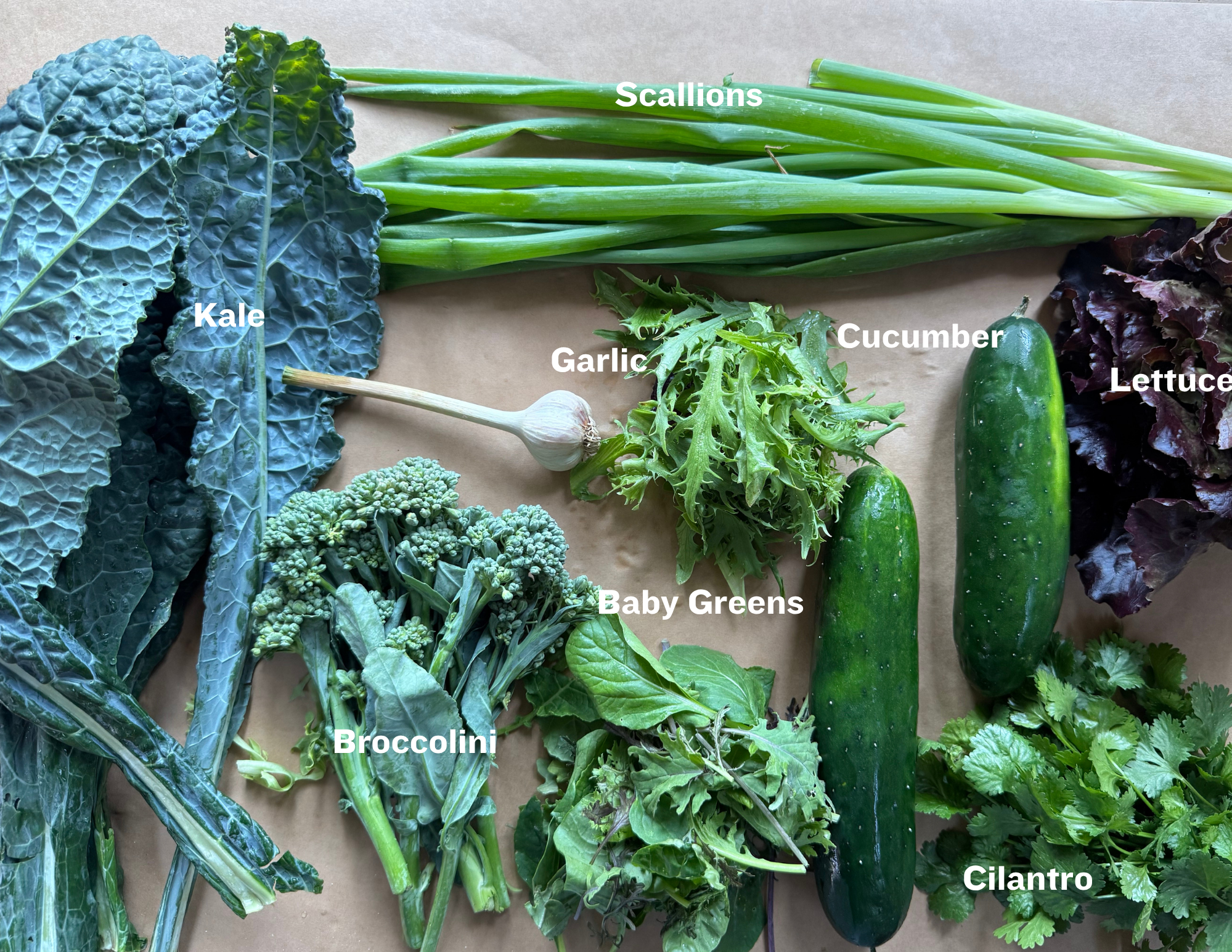
garlic, cilantro, kale, baby greens, lettuce, beets, cucumber
Large Share:
garlic, scallions, cilantro, kale, baby greens, lettuce, broccolini, cucumber
-
This cucumber salad recipe is one of the simplest summer side dishes, and if you ask us, it’s also one of the best.
Featuring cilantro and scallions, this is a great base for a burrito bowl or your favorite stir fry.
Tomato, Kale and Mozzarella Sandwich with Parsley PestoA sandwich showcasing the very best of the summer season.
-
Originally from India, cucumbers are popular worldwide, either fresh or pickled. Crunchy and refreshing, cucumbers are great in a summer salad or cold soup. Tasty Jade cucumbers are a seedless Asian variety with thinner, less bitter skin. Classic slicing cucumbers have thicker, slightly bumpy skin, allowing them a longer shelf life. Gherkins are smaller varieties generally used for pickling because they stay crunchy but are also delicious raw.
-
Garlic is one of our favorite crops because it is available in slightly different forms all year round. We get green garlic throughout the spring, garlic scapes in June, fresh garlic heads in July, and mature cured garlic beginning in late summer that lasts until next spring if we’re lucky. Green garlic is just a young garlic plant; much of the stem and leaves are edible and slightly milder in flavor than cured garlic. Garlic resembles a leek at this early stage and can be treated similarly. Once the garlic has developed into a full bulb, in early to mid-July, we mass harvest this crop and cure it, a process that dries the papery skin of the bulbs so they can be stored through the winter. Garlic is essential in almost every recipe
-
Hi from the fields,
Our crew is always busy but the second week of July is a uniquely jam-packed time at the farm. This is a week when a lot of long-term projects come to fruition – we’re harvesting garlic and grain that was planted last October and tasting the season’s first sungolds which we seeded in the greenhouse mid-March. As farmers we think about time constantly: how many days to maturity a crop is, how many hours can we afford to spend weeding this round of peppers, how long do we let our garlic size up before we risk splitting, how long of an irrigation set can we run this week? We rely on systems to organize the enormous amount of work to do each week – spreadsheets tracking a crop’s availability, several drafts of the CSA box, scrupulously detailed crop notes, our weekly crew meeting to talk through priorities and projects, our daily plan and team assignments broken down hour by hour. The challenge (and magic) of farming is that no matter how much you prepare, there are always things out of your control: pest and disease pressure, rain, heat waves, equipment breakdowns, etc. The endless variables are what makes farming hard and what makes it so special. We aren’t in opposition to nature, we’re working with it – we adapt, we pivot, we let go of our meticulous plan and figure out a new one.
Everything in your box is the product of months, weeks, days, and hours of collaboration as a team to make it happen. As we crest into the peak of summer, I want to acknowledge the crew for all of the hard work they’ve put in to get to this point. I’ve been blown away by their commitment and curiosity, their ability to roll with the punches, and their tireless work ethic. Farming is so hard for so many reasons but they make it feel easy.
Love + garlic,
Amelia
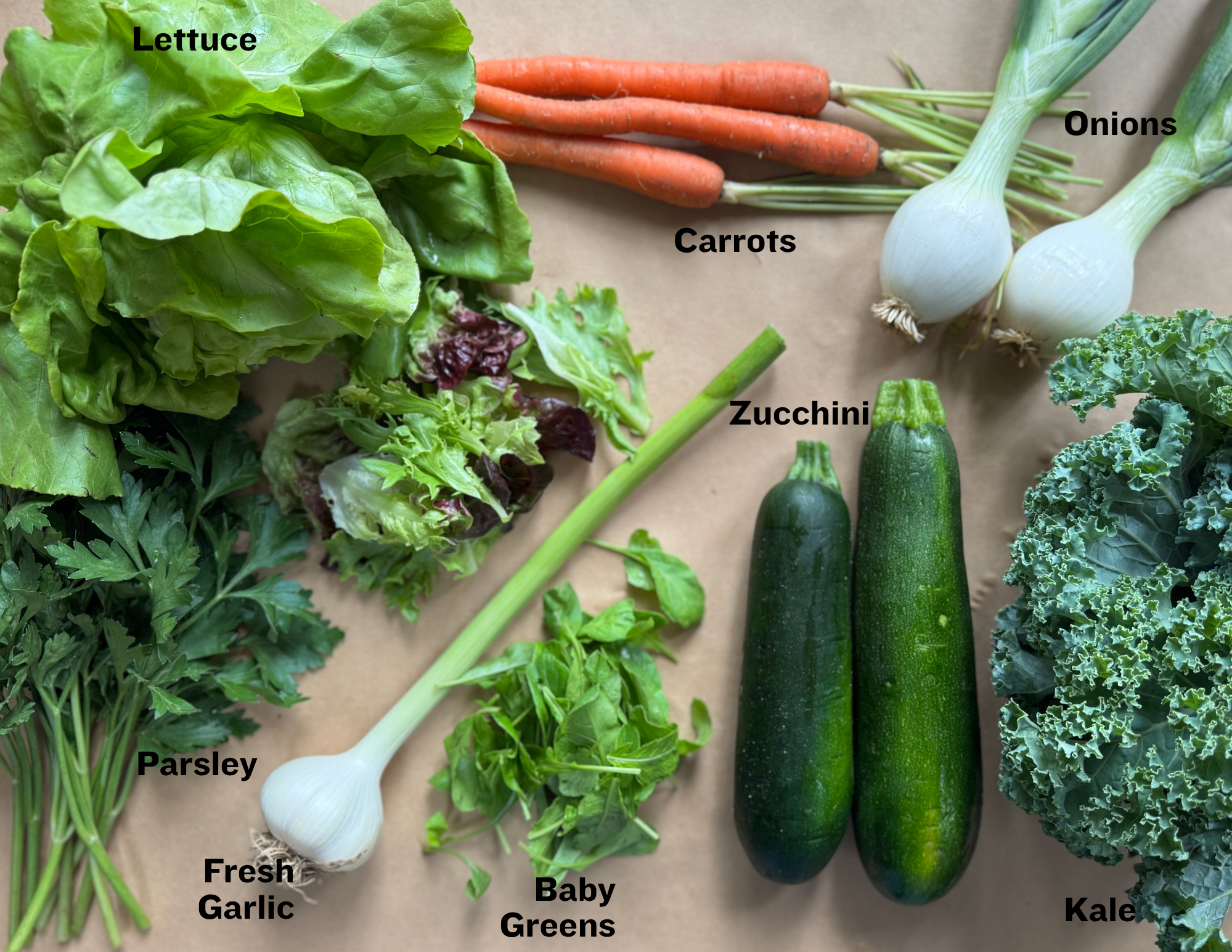
Week of July 7th
-
Small Share:
Fresh garlic, onion, parsley, kale, lettuce, carrots, zucchini
Large Share:
Fresh garlic, onion, parsley, swiss chard, baby greens, lettuce, carrots, zucchini
-
So simple and so delicious- a great use for all of the zucchini coming your way.
A vibrant lentil salad combines farm-fresh herbs, peppery greens, and a bright lemon vinaigrette for a fresh, protein-packed dish that celebrates seasonal produce.
Carrots with Tahini Ginger DressingA simple salad celebrating the first carrots of the season.
-
Surprisingly, carrots were originally purple but were bred to be orange in the 16th century. Purple carrots are sweeter, and white carrots have more pepperiness. Carrots are loaded with beta-carotene, an antioxidant your body converts into vitamin A. You can also eat the carrot tops—try making pesto or using them as a garnish for a carrot-based dish.
Carrots with onion and celery are the base of most soups, stews and braised dishes. Carrots can be roasted, grilled, pureed, steamed, stir-fried or sauteed or the main ingredient in carrot cake.
-
Garlic is one of our favorite crops because it is available in slightly different forms all year round. We get green garlic throughout the spring, garlic scapes in June, fresh garlic heads in July, and mature cured garlic beginning in late summer that lasts until next spring if we’re lucky. Green garlic is just a young garlic plant; much of the stem and leaves are edible and slightly milder in flavor than cured garlic. Garlic resembles a leek at this early stage and can be treated similarly. Once the garlic has developed into a full bulb, in early to mid-July, we mass harvest this crop and cure it, a process that dries the papery skin of the bulbs so they can be stored through the winter. Garlic is essential in almost every recipe
-
Hello from the fields,
Phew, that was a hot one last week for the field crew! Out in the fields the crew has no real escape from sweltering, sticky, still conditions, apart from choosing the coolest part of the day to work, which is just what we did last week. Everyone hit the fields by 6am (some even at 5) - an hour earlier than our typical start time - in order to get as much as possible done in the cool morning hours before early dismissal around lunch. We prioritized only the most critical work during the heat wave: harvesting and seeding, and opted out of our typical afternoon tasks of weeding, trellising, and transplanting, which we’ll catch up on this week. Last week’s weather makes us particularly grateful to farm where we do, with an almost constant ocean breeze and nearby water where we can cool down at lunch or after work.
The middle of July is a joyous and incredibly busy time on the farm - where “regular” harvesting collides with the annual garlic and wheat harvests, plus the weeds really speed up in July, and also, it’s hot! After yesterday’s (much needed) rain we’re back at it in the fields, harvesting for weekly boxes, the market, and kitchen, and by the end of this week beginning to pull the 15,000-heads of garlic sown last fall. Then next week: wheat!
More updates to come, enjoy the box and have a great week!
Amanda + Katie + The Amber Waves Team
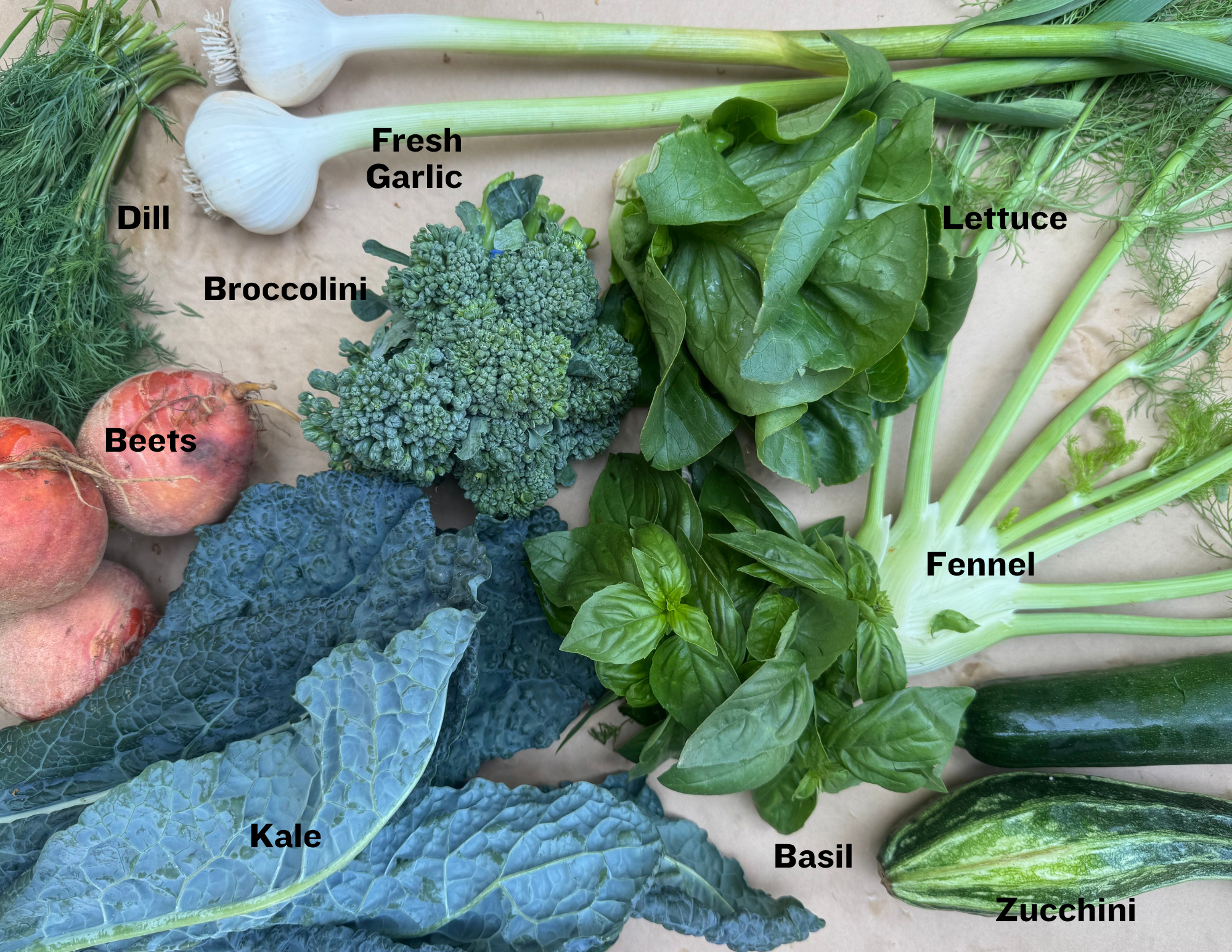
Week of June 30th
-
Small Share:
fresh Garlic, scallions, basil, dill, lettuce, fennel, beets, broccolini
Large Share:
fresh garlic, basil, dill, kale, lettuce, fennel, zucchini, beets, broccolini
-
A fun riff on pesto from Susan Spungen's "Veg Forward" cookbook.
Grilled Zucchini with Garlic and Dill
This grilled zucchini is tossed in a bright, garlicky dill dressing that turns summer squash into a fresh, flavorful side for all season long.
This fennel salad is a crisp, refreshing summer side--- bright and crunchy, it balances grilled dishes and other warm-weather meals.
-
The fennel bulb is crisp, sweet, and reminiscent of anise or licorice.
Use it raw, thinly sliced in a salad, or mellow the anise flavor by roasting the bulbs until caramelized.
You can also eat the stalks and the leaves, known as fronds.
-
The leafy herbs grown in the herb garden and our fields are available between late spring and fall. Some herbs, like basil and cilantro, are more challenging to grow in summer due to disease and heat intolerance. Leafy herbs are flavorful and can transform a dish by providing freshness and vibrant green color.
Storage: Putting basil in the fridge when it’s wet causes it to turn black - so don’t wash it before you put it away! To prolong its freshness, cut the bottom off the stems and place them in a shallow cup of water outside the fridge or keep (unwashed) basil in plastic in the fridge. Store other fresh leafy herbs in the fridge in a glass of shallow water with a plastic bag covering the top. Change the water every day or two. Leafy herbs will last up to two weeks if stored properly.
● Basil: A classic summer herb, basil is most commonly used for pesto. Combine basil, garlic, olive oil, and a nut or seed in the food processor, toss with your favorite pasta, or enjoy with fresh tomatoes and mozzarella. To have basil year-round, try freezing pesto in ice cube trays and transferring it to a plastic bag. When using fresh basil, cut it into ribbons rather than small pieces to avoid bruising.
-
A warm welcome to all of our new and returning July members! You’re joining us just as some of our favorite crops - garlic, zucchini, and basil - are making their CSA debut. By the end of this month, we will be harvesting tomatoes, cucumbers, and carrots to accompany the leafy salad greens we send home with you each week. It’s an exciting time of year on the farm, and an exciting time to bring home and cook with your first CSA box.
This week’s update comes not from our fields, but from many backyards in your community. Every spring, we donate hundreds of vegetable and herb seedlings to our food pantry partners throughout the East End - the same seedlings in biodegradable pots that fill our market in May and June. Over the winter, we incorporate these donations into our seed order and our seeding plan for the spring, and then our farmers spend many greenhouse hours carefully planting, potting up, labeling, and watering the plants until they are ready to be sent to their forever homes with our neighbors.
We’ve known that the seedlings are well received by food pantry families, but were surprised this spring to learn how great the demand for them actually is. Last year, we sent 1,000 seedlings to three of our regular food pantry partners; this year, four additional agencies requested plants from us, bringing our total number of donated seedlings to over 1,800.
Our motivation for the program has always been to increase food access in our community and to give food pantry recipients greater choice in their diet. This year, we discovered that the seedlings do so much more than just meet those basic needs. South American families at Heart of the Hamptons said they want to grow foods that taste like home - cilantro, tomatoes, and a wide range of peppers. A father at the Bridgehampton Child Care Center scooped up a bunch of zucchini plants because gardening is one of his favorite ways to spend time with his young son. Residents at a nearby affordable housing complex requested flower seedlings to beautify their common areas and community garden. And the pre-k students at the Springs School just can’t stop talking about how those biodegradable pots are actually made from cow poop.
We wish them all a happy, healthy, and meaningful growing season.
—Jess
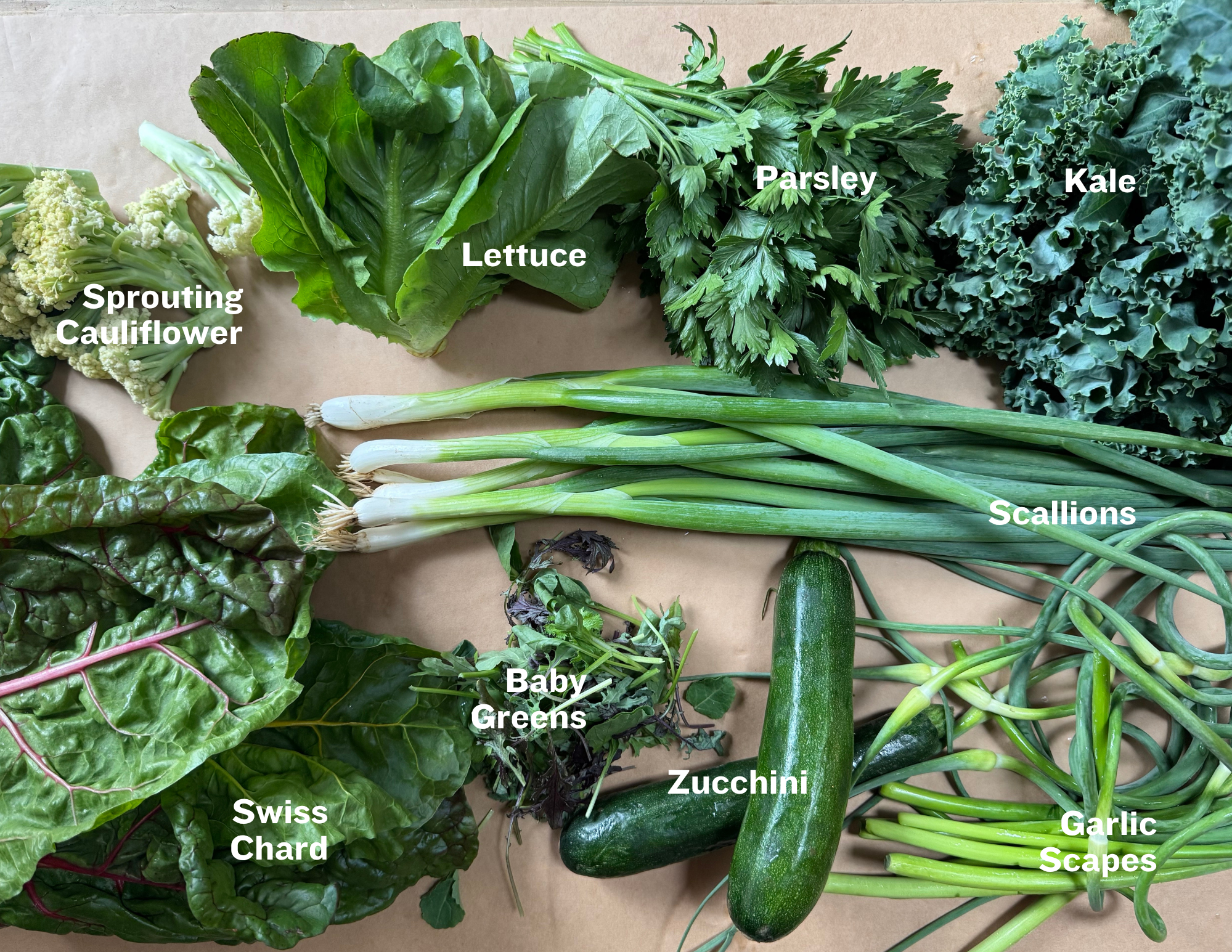
Week of June 23rd
-
Small Share:
garlic scapes, parsley, kale, baby greens, lettuce, zucchini
Large Share:
garlic scapes, scallions, parsley, swiss chard, kale, baby greens, lettuce, zucchini, sprouting cauliflower
-
Bright and vibrant sauce perfect for your favorite protein or grilled veggies
A delightful preparation of chard, recommended by one of our CSA members.
Fried Sprouted Cauliflower
Matty Matheson’s proves sometimes the best meals come from the simplest ingredients done really, really well.
Ingredients
Cauliflower & Marinade:
2 heads sprouting cauliflower
4 cups buttermilk
1 teaspoon kosher salt
Roasted Jalapeños:
2 jalapeños
2 tablespoons unsalted butter
1 sweet onion, thinly sliced
Spicy Mayonnaise:
6 pieces pickled cherry pepper
6 pieces pickled pepperoncini
¼ cup ketchup
1 tablespoon white vinegar
1 teaspoon Spanish paprika
½ teaspoon kosher salt
¼ teaspoon garlic powder
2 cups mayonnaise
Cheese Sauce:
2 tablespoons unsalted butter
2 tablespoons all-purpose flour
1 cup milk
1 cup shredded Monterey Jack cheese
Cornmeal Batter:
1½ cups all-purpose flour
1½ cups semolina flour
½ cup cornmeal
½ teaspoon garlic powder
½ teaspoon onion powder
1 teaspoon sweet smoked paprika
¼ teaspoon cayenne
1 teaspoon kosher salt
2¾ cups soda water
¼ cup vodka
For Frying & Assembly:
2 cups all-purpose flour
4 cups vegetable oil
Unsalted butter
Eight 1-inch-thick slices brioche
Steps
Prepare cauliflower: Trim tough ends of cauliflower and discard. Whisk together buttermilk and salt. Add cauliflower to mixture, make sure it's fully coated. Cover with plastic wrap and refrigerate for at least 2 hours.
Roast jalapeños: Preheat oven to broil. Place jalapeños on baking sheet and broil until skin is blistered and charred, 4 to 6 minutes. Remove and let cool. Peel and slice. In a skillet, melt butter over medium heat, add onion and cook, stirring occasionally, until caramelized and golden brown, 10 to 12 minutes. Mix roasted jalapeños with onions and set aside.
Make spicy mayonnaise: Remove seeds and stems from pickled peppers and pepperoncini. In a food processor, blend together the pickled peppers, pepperoncini, ketchup, vinegar, paprika, salt, and garlic powder. Transfer to a bowl, add mayonnaise, and whisk together until combined. Place in airtight container and refrigerate up to 1 week.
Make cheese sauce: In a medium saucepan, melt butter over medium heat. Whisk in flour and make a roux for about 10 minutes. Once turning brown, slowly whisk in milk. Turn off heat and add cheese and whisk until melted. Cover and save for later.
Make cornmeal batter: In a large bowl, whisk together flour, semolina flour, cornmeal, garlic powder, onion powder, smoked paprika, cayenne, and salt. Gradually add soda water and vodka while whisking until smooth batter forms. Set aside.
Fry cauliflower: Remove marinated cauliflower from buttermilk, allowing excess liquid to drip off. Place in flour bowl and dredge cauliflower, dusting off excess. Dip dredged cauliflower in cornmeal batter, making sure evenly coated. Set on wire rack while heating oil.
Cook: Line a plate with paper towels. In a Dutch oven over medium-high heat, heat vegetable oil to 350°F. Add cornmeal-battered cauliflower in batches and fry until golden and crispy, turning occasionally, about 30 seconds. Using tongs, remove fried cauliflower and transfer to paper towel-lined plate. Season with a sprinkle of salt.
Assemble sandwich: Preheat skillet or griddle over medium heat. Butter each slice of brioche toast both sides. Add spicy mayo to the base, then the onion mixture, your fried cauliflower, and cheese sauce. Top with the other slice of toast.
-
Scallions or green onions, are simply an onion variety that doesn’t form a bulb.
Some prefer only to use the white or purple portion, but you can use most of the green part, although the very top may be a little tougher. With their milder flavor, scallions are more commonly eaten raw than regular onions. We like to use them as a garnish to add brightness to a dish, especially those with Asian flavors.
-
In the cucurbit family, zucchini is a summer crop, available between June and late summer. They take between 50 and 60 days to reach maturity. It is particularly susceptible to disease, making them difficult to grow, especially organically. Zucchini is a good source of vitamins C and B-6.
Storage: Zucchini lasts about five days in the fridge. They bruise easily, so treat them gently and avoid nicking the skin.
At the farm, we use “zucchini” and “summer squash” interchangeably, with zucchini referring to green varieties and squash to yellow varieties. A summer staple, zucchini is fantastic on the grill. Our favorite type is an Italian heirloom variety called Costata Romanesco, which has incredibly tender flesh with a slightly nutty flavor. Try shredding to make zucchini pancakes or using a spiralizer to make “zoodles.”
-
Hear from graduated apprentice and current Amber Waves farmer, Natalie on how we are getting ready for one of our favorite times of year, tomato season. Natalie takes us on a POV journey through a farm chore that's critical for ensuring our tomatoes thrive.
Our farmers work tirelessly on planting, growing, harvesting over 350 varieties of vegetables almost all year long.
Stay tuned for messages from our amazing farm team this season, they're not only wonderful humans but each has a unique perspective on what it takes to produce exceptional food on the East End.
We can't wait for you to get to know the people behind your produce.
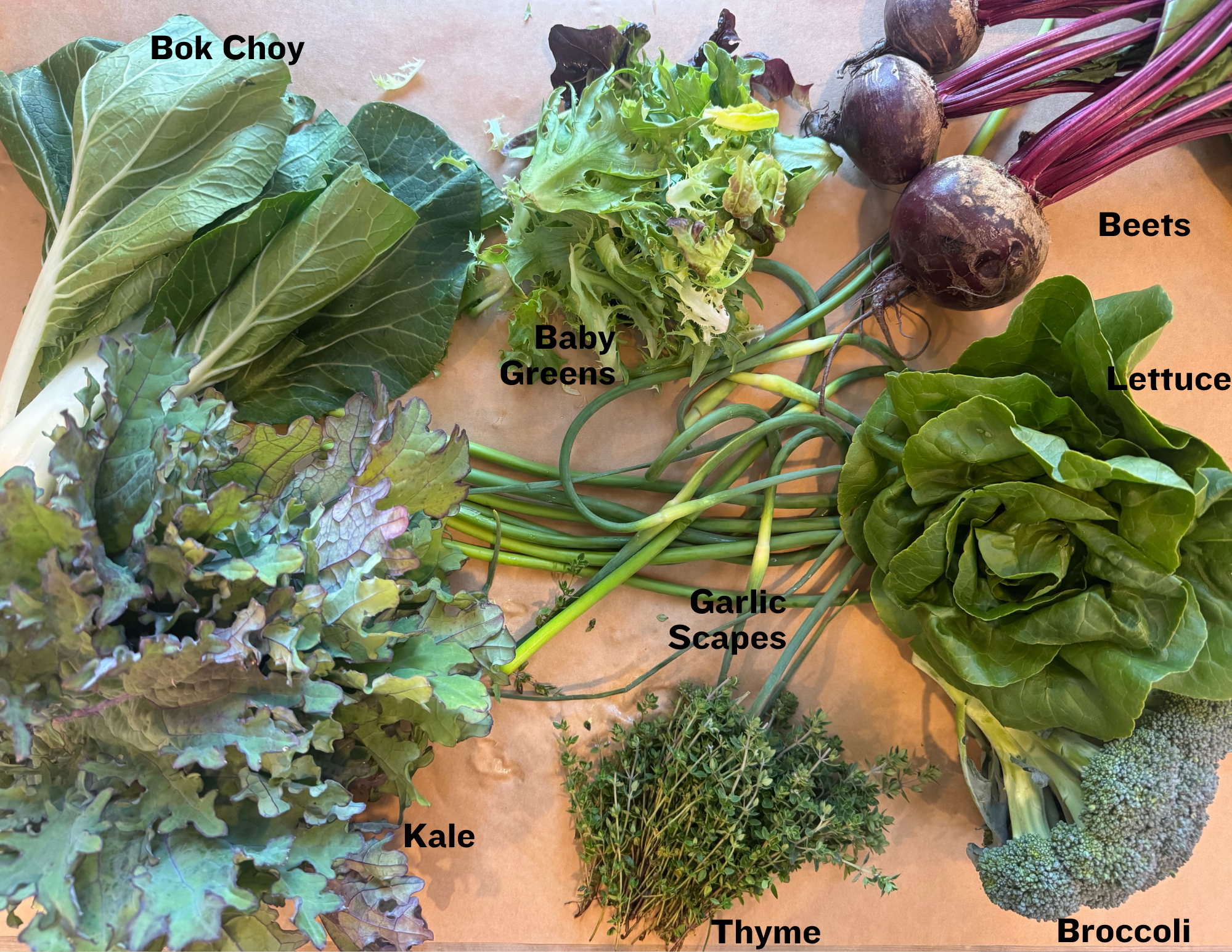
Week of June 16th
-
Small Share:
Garlic scapes, thyme, collards, baby greens, beets, broccoli
Large Share:
Garlic scapes,thyme, kale, bok choy, baby greens, lettuce, beets, kohlrabi, broccoli
-
Swap beets for tuna in this vegan take on a favorite summertime dish.
A fun, satisfying side dish.
One pan is all you need!
-
Deep maroon red beets add stunning color and earthy flavor to any dish. Golden beets are slightly milder, while the sweeter Chioggia beets are an Italian heirloom with gorgeous candy cane red and white rings. Our beets are small to medium-sized with thin skin, making them perfect for roasting without the hassle of peeling. Try cooking the greens like spinach - they are very nutritious and high in iron
-
Leafy greens are some of the most nutritious vegetables we grow, high in B vitamins, iron, vitamin K, folate, and magnesium. The flavor of some greens (especially chard and broccoli rabe) can be strong, so while they can be eaten raw, these greens are most commonly cooked.
Our bunched cooking greens are available from spring to late fall (May-November) and take 40 to 70 days to reach maturity. Many of these greens are “cut and come again,” meaning they produce over a long period, producing new growth throughout the season (as opposed to head lettuce, a “one-hit wonder” that does not grow back).
Storage: Store cooking greens in the refrigerator in a perforated plastic bag with a damp paper towel. They will last between four days and a week.
-
Hear from graduated apprentice and current Amber Waves farmer, Natalie on how we are getting ready for one of our favorite times of year, tomato season. Natalie takes us on a POV journey through a farm chore that's critical for ensuring our tomatoes thrive.
Our farmers work tirelessly on planting, growing, harvesting over 350 varieties of vegetables almost all year long.
Stay tuned for messages from our amazing farm team this season, they're not only wonderful humans but each has a unique perspective on what it takes to produce exceptional food on the East End.
We can't wait for you to get to know the people behind your produce.
Week of June 9th
-
Small Share:
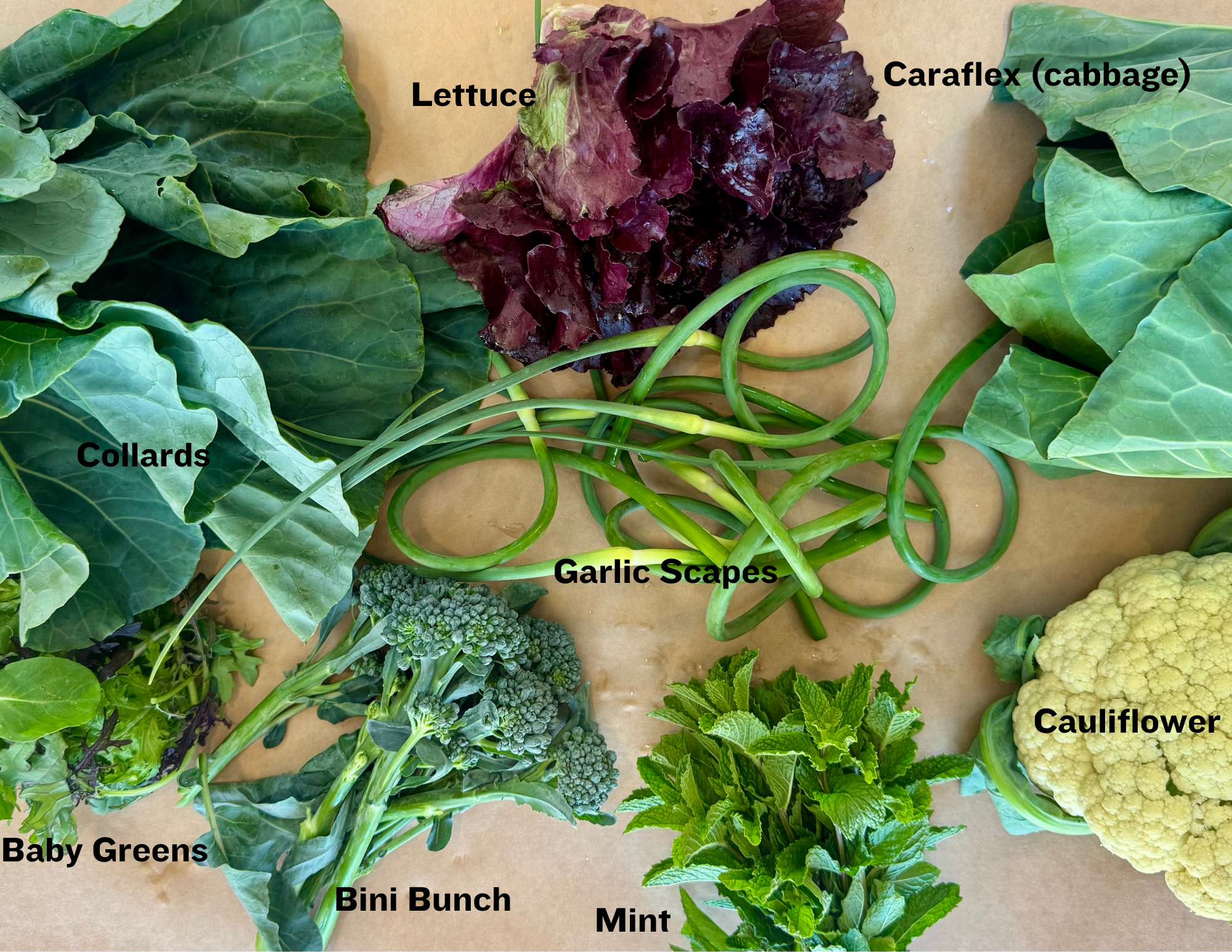
garlic scapes, mint, swiss chard, baby greens, lettuce, bini bunch
Large Share:
garlic scapes, mint, collards, caraflex, baby greens, lettuce, cauliflower, bini bunch
-
Cauliflower is the star in version of the popular stirfry dish.
Roasted Broccolini with Parmesan-Pine Nut Pangritata
A quick char in the oven results in a flavorful side dish with Italian roots.
Use as a dip for crudites or grilled veggies.
Kicking off fruit season with this Mark Bittman creation that is “nearly effortless and as good or better than a pie.”
Quick, Easy and Delicious Tips: Mint
We have many varieties of mint, including apple mint, peppermint, and spearmint,
each with a slightly different appearance and flavor. Our favorite thing to do in the summer is
to make sun tea with a mixture of varieties for a cooling drink.
-
We have many varieties of mint, including apple mint, peppermint, and spearmint, each with a slightly different appearance and flavor. Our favorite thing to do in the summer is to make sun tea with a mixture of varieties for a cooling drink.
-
Amber Waves grows hardneck varieties of garlic compared to the softneck varieties you may see at the supermarket. The softneck varieties are easier to grow and store longer, but are less flavorful. Hardneck garlic has fewer and larger cloves than its softneck cousin and produces a stalk in the spring that turns into a flower bud called a scape. We harvest the scapes to redirect the plant’s energy to developing cloves, which means you get to enjoy them! The beautifully curled scapes are milder than garlic but still pack a strong punch. Use them in place of garlic in any recipe or add them raw to salad dressings or pesto - just don’t use the tapered end, which can be a little tough and fibrous.
Our favorite way to eat scapes is roasted or grilled whole, which considerably mellows their spiciness. Before grilling, season with a little olive oil, salt, and pepper and roast until charred.
You can use them just like garlic. Roast, saute, or add them to soups or stews. You can also pickle them.
Garlic scapes should be stored in an airtight container in the crisper drawer for 1-2 weeks.
Alternatively, they can be kept like flowers in a glass jar or vase with cold water (change the water daily) and used in a few days.
-
Throughout the season we will be featuring notes from our apprentices. It is your chance, as a CSA member, to get to know a little bit more about our Apprenticeship Program and about these outstanding farmers as they navigate through an intensive season of growing.
The fields are definitely waking up from winter and cranking out the joys of June! We’ve been harvesting kale, chard, kohlrabi, broccolini, broccoli, broccoli rabe, cauliflower, lettuce, baby greens, herbs, green garlic, garlic scapes, radishes, spinach, and a plethora of edible flowers. It’s a hundred percent brassica (kale, broccoli, etc. family) season and I’ve been loving every minute of it!! I’m personally the most excited about the garlic scapes—pesto galore, grilled scapes, compound butter with scapes—I can’t resist harvesting a handful for myself every time I pass them! Even more exciting, it means cured garlic is coming soon!
So far I’ve been feeling really fulfilled and nourished as an apprentice at Amber Waves. I feel so grateful to be given so many different opportunities to learn and grow while still being supported by the other farmers here. It’s so special to get to witness how much thought and care is put in by everyone into growing food for so many people, it’s really inspiring. Before coming here, I had heard nothing but good things about the sense of community at this farm, and I have to say it definitely lives above and beyond its reputation. I’m feeling really excited about winter squash season, but I am even more excited about developing my tractor skills and becoming a much stronger driver!
I really hope you as a CSA member have been enjoying the boxes and hopefully you can taste the love and care that we put into seeding, growing, and harvesting for you! We’ve been thinking of you guys for months and we’re so excited to get to share our work with you!!-Apprentice Gracie
Week of June 2nd
-
Small Share:
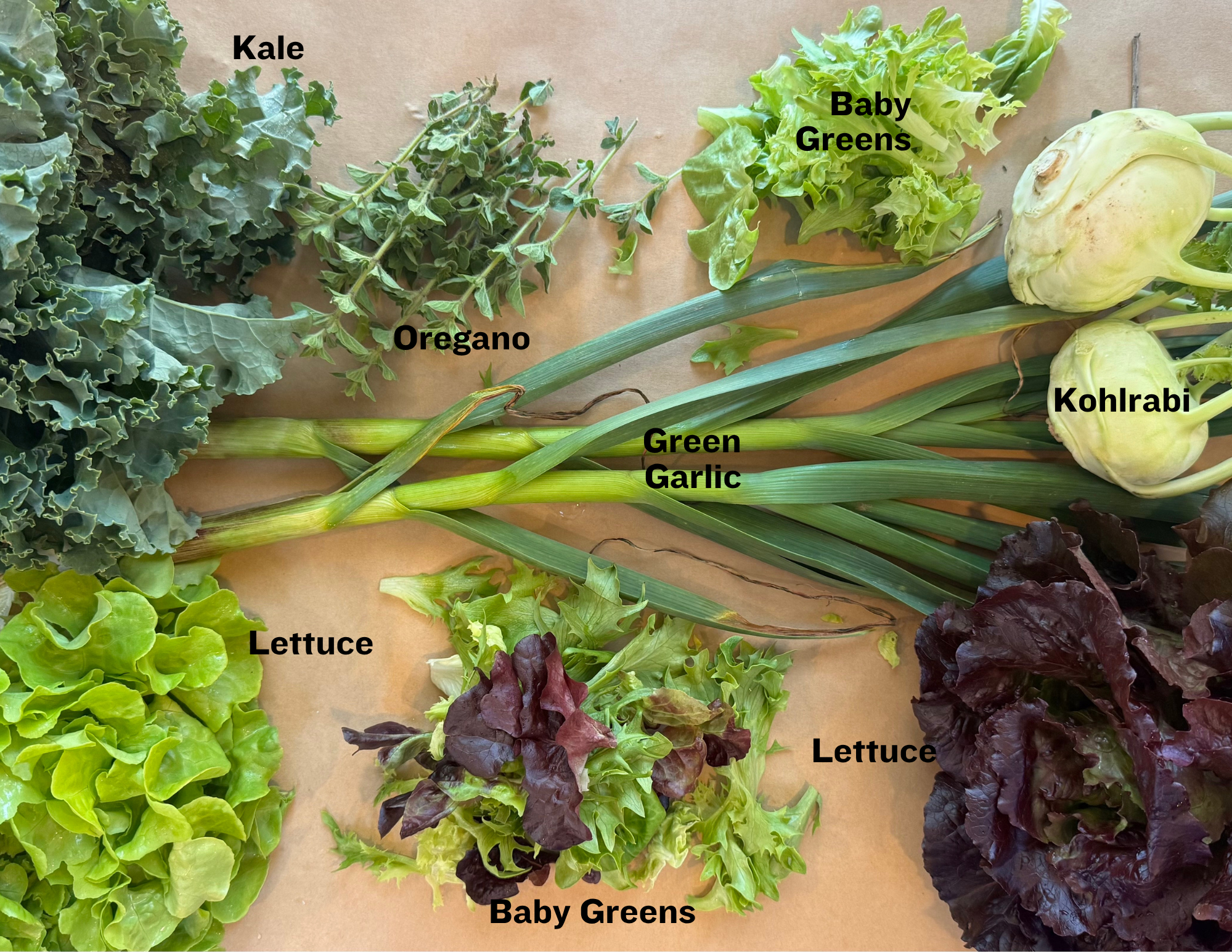
green garlic, oregano, kale, broccoli rabe, lettuce, baby greens, kohlrabi
Large Share:
green garlic, oregano, kale, saute bouquet, bok choy, lettuce, baby greens, kohlrabi
-
A light, lovely side dish highlighting one of our favorite brassicas.
Orecchiette with Broccoli Rabe
This recipe uses meat free sausage but feel free to substitute the real thing.
Use Lacinato or Curly kale in this delightful and versatile salad.
-
Quick, Easy & Delicious Tips: Baby Greens
Baby greens are one of the fastest crops we grow, ready in weeks from when we sow seeds directly into the soil, depending on the time of year. More tender than full-sized greens, baby greens are perfect to use raw in a salad. Many of these crops don’t like the heat, making it difficult to grow in the hot summer months. Despite this challenge, we do our best to get baby greens into your boxes as often as possible. These greens are a great folate, vitamin K, and vitamin A source.
Storage: The bagged baby greens in your box have been pre-washed. Fresh baby greens can be stored in a plastic bag or container surrounded by damp paper towels in the refrigerator for up to five days.
Spinach: Spinach is a versatile and nutritious green with a smooth, almost succulent texture and rich flavor. We love spinach salad with goat cheese and beets!
Arugula: Arugula, also known as rocket, has a spicy bite that makes salads more exciting. In the heat of the summer, it gets even more peppery. Try adding raw arugula to the top of a pizza while still hot!
Baby Kale: Our favorite baby kale variety is called Red Russian. Its tender yet sturdy leaves are perfect for quickly adding to a raw salad or sauteing. Look for its signature blue-green leaves and light purple stems in your box this year.
Salad Mixes: We grow a few different greens mixes at the farm! Each mix has a variety of colors, flavors, and textures to add to a salad. Our signature “spicy salad” mix is a mixture of Asian greens, such as mizuna and bok choy, along with burgundy mustards that give the mix a flavorful, spicy bite! Our other mixes aim to please with different varieties of greens, colors, textures and flavors.
-
This alien-looking vegetable is quite mild in flavor and has the texture of a tender broccoli stem. Often eaten sliced raw in crudites, kohlrabi can also be roasted. As with other vegetables, a larger size coincides with thicker skin, so while baby kohlrabis are tender all the way through, very mature heads are better peeled. Like all other brassicas, the leaves are edible, and you can treat them like kale or any other cooking green
-
Hello from the fields,
This week we’d love to introduce you to our 2026 cohort of apprentices. This energetic, eager group arrived in late March for an intensive season of training on the farm, craving the skills they’ll need to start their own farms one day. They learn by doing - being fully immersed in the daily work of the fields, and also through our written curriculum that guides them through the more technical components of agriculture, one week at a time all season long.
As the products of an Apprenticeship Program ourselves (at Quail Hill Farm around the corner), Katie and I started our new farmer training program to pay it forward, doing our part to provide critical knowledge to newcomers in our industry, where the average age of a farmer is 58 years old. In the 15 years since we have started our program, more than 60 young people have graduated, starting several new farms and food businesses of their own around the country. Training new farmers is at the core of our daily work on the farm and is the most labor-intensive, expensive of our mission-driven programs. It’s also my favorite thing we do; interacting with and instructing our energetic team of apprentices never gets old, and I love learning what our alumni have gone on to accomplish. Happily, many of our alumni are still with us, making up nearly all of the farm’s middle and upper management positions; it’s extraordinary to watch the evolution of the knowledge and skills each season. We hope you’ll take advantage of the chance to meet a farmer this season at CSA pickup or in the Pick Your Own fields, their work ethic and expertise is what keeps the farm going!
A little more, just for fun:
Watch this (less than 5 minute) video featuring our 2024 apprentice crew
Watch or listen to one of our favorite 2025 Farmcast episodes where Katie and I chat with Farm Manager Amelia about her career in farming, starting as an apprentice and now overseeing the whole farming operation
Enjoy the box!
Amanda + Katie + The Amber Waves Team
Week of May 26th
-
Small Share:
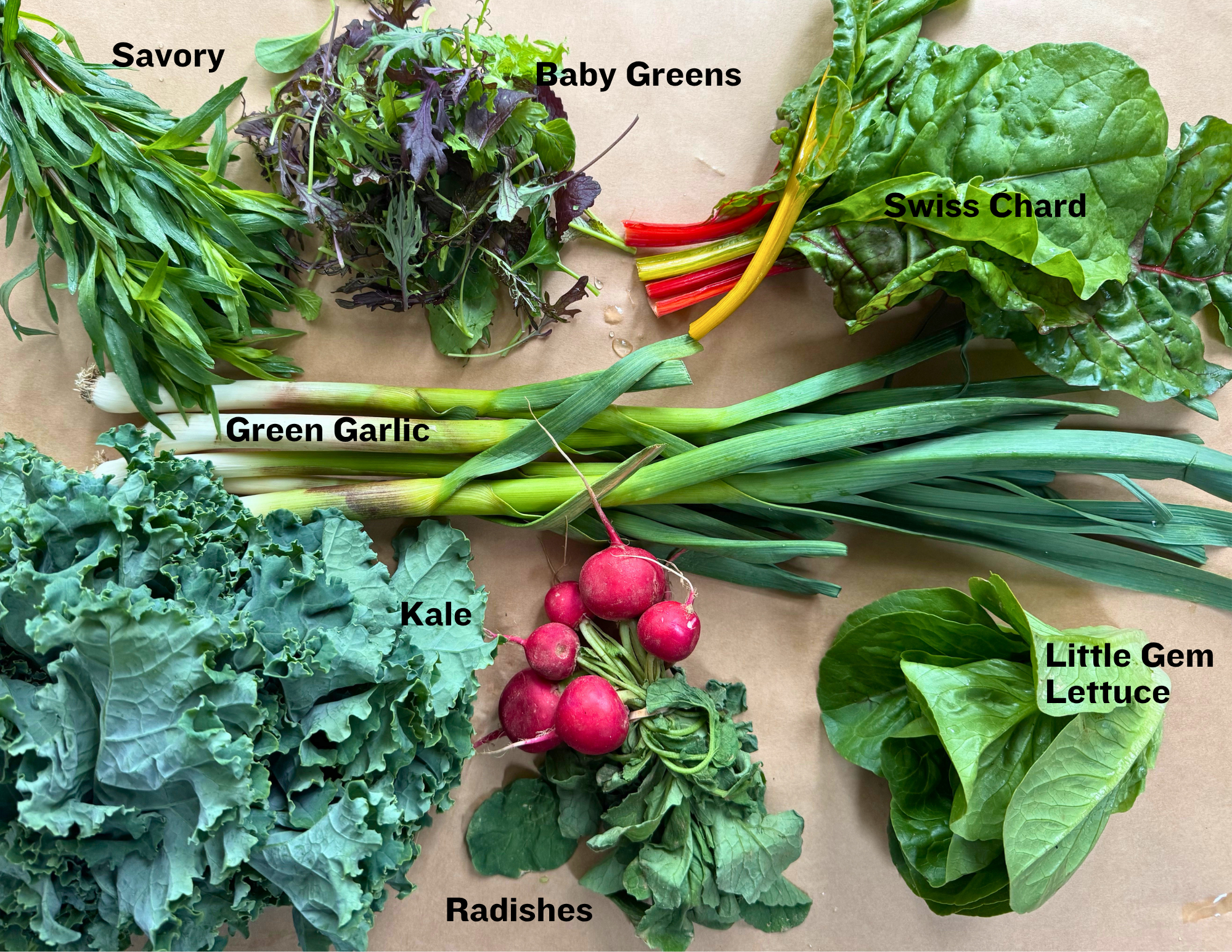
green garlic, savory, kale, baby greens, little gem lettuce
Large Share:
green garlic, savory, swiss chard, broccoli raab, baby greens, baby kale, radishes
-
Make the dough or buy it- this pizza is highlighted by fresh herbs and topped with bright, peppery greens.
Thai-Inspired Coconut Curry Soup with Spring Vegetables
We are still enjoying cool spring evenings and this soup is perfect for that. Easily customizable- use your green garlic, last weeks sweet potatoes, and bonus bok choy.
Simple and satisfying, use savory to give nuance and depth to this classic side.
-
Quick, Easy & Delicious Tips: Savory (Winter & Summer)
Savory is a fragrant herb that comes in two main varieties—winter savory and summer savory. Both share a bright, grassy, peppery flavor, but winter savory is a bit more robust and aromatic, making it especially great for slow-cooked dishes.Try adding chopped savory to soups, stews, and bean dishes to deepen the broth and bring out a subtle peppery warmth. It holds up well during cooking, so you can toss it in early without losing its flavor.
Here’s a favorite way to use it—stir fresh chopped savory into a pot of white beans, lentils, or roasted vegetable soup right as it simmers. It adds a savory backbone that makes the whole dish taste more developed and comforting.
Savory also pairs beautifully with roasted potatoes or carrots—just sprinkle it on before roasting for an herby, aromatic finish.
-
Baby greens are one of the fastest crops we grow, ready in weeks from when we sow seeds directly into the soil, depending on the time of year. More tender than full-sized greens, baby greens are perfect to use raw in a salad. Many of these crops don’t like the heat, making it difficult to grow in the hot summer months. Despite this challenge, we do our best to get baby greens into your boxes as often as possible. These greens are a great source of folate, vitamin K, and vitamin A.
Storage: The bagged baby greens in your box have been pre-washed. Fresh baby greens can be stored in a plastic bag or container surrounded by damp paper towels in the refrigerator for up to five days.
-
Hello from the fields,
While no one was thrilled about Memorial Day weekend being a complete washout, the fields did need the rain. We have many linear miles of greens planted out there that very much appreciate the wet weather, and will slurp up every bit of moisture they can as they really begin to thrive in these warmer (but still mild) temperatures of late spring. This week’s box is heavy with a variety of these greens; and while we group them into that big “greens” category you’ll find a delicious and colorful variety of leaves in your box for salads, stir fries, smoothies, or roasted beneath chicken or filet of fish (we also love grilling greens now that we’re cooking our own dinners outdoors - try it!). Being part of a CSA is an extraordinary way to experience (and experiment with) the flavors of the season in real time and to welcome the arrival of new crops each week; over the course of the season no two weeks will be the same. Out in the field the farm crew is spending their mornings filling your boxes with what was planted a month or more ago, spending their afternoons tending to crops that will make up your summer boxes, and, importantly, making time to seed fall crops in the greenhouses - our minds are always a season or two ahead!
We hope you enjoy your second box of the season, see you next week!
Amanda + Katie + The Amber Waves Team
Week of May 19th
-
Small Share:
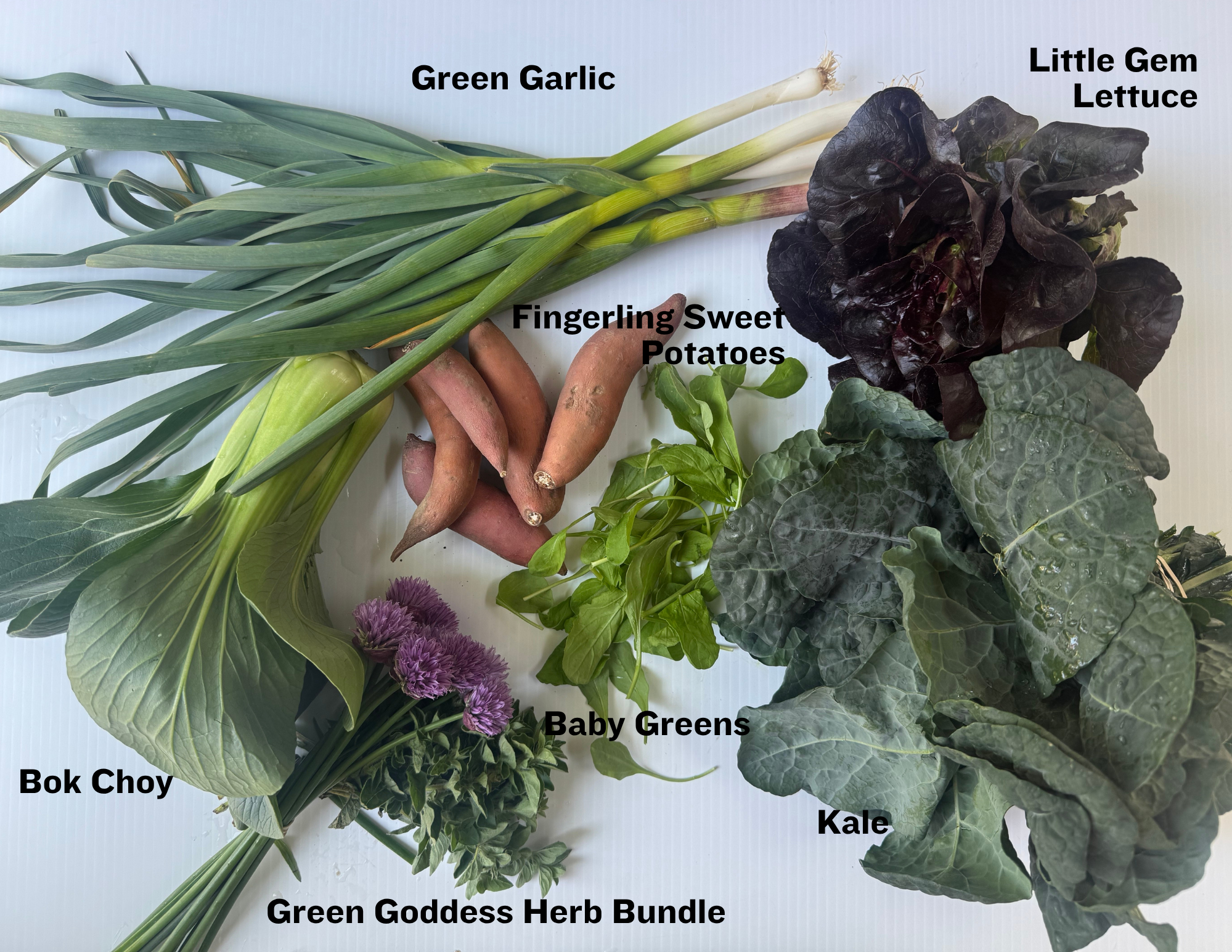
Green Garlic, Green Goddess Herb Bundle (Chive Flowers, Mint, Oregano, Tarragon), Bok Choy, Saute Bouquet, Baby Greens, Fingerling Sweet Potatoes
Large Share:
Green Garlic, Green Goddess Herb Bundle (Chive Flowers, Mint, Oregano, Tarragon), Bok Choy, Kale, Baby Greens, Little Gem Lettuce, Fingerling Sweet Potatoes
-
A simple, flavor packed side dish. Bonus: use your green garlic in place of the garlic.
Top your spring greens with this bright, flavorful dressing- or use it for a dip for your favorite crudites.
Kale, Tomato, and Lemon One-Pot Spaghetti
An easy, weeknight dinner using pantry staples and your abundance of spring greens.
-
Quick, Easy & Delicious Tips: Green Garlic
Enjoy the whole green garlic stalk, which is actually the young garlic plant. Chop, mince, dice, and slice the white bulb and green stalk as you would garlic. Add chopped green garlic with roasted assorted vegetables. The green garlic will get crispy and even more delicious—it turns into delicious garlic chips!
Here’s a favorite way to enjoy radishes - Eat them cold with green garlic butter and flaky sea salt.
-
Your green goddess herb bundle consists of chive blossoms, mint, oregano and tarragon.
Add your green goddess herbs to Greek yogurt or blend into hummus for a tasty radish dip.
Combine chopped green garlic with your herbs and blend with oil and vinegar for a flavorful dressing. The dressing would be delicious, drizzled over roasted sweet potatoes!
-
Hello from the fields,
Welcome everyone, to the 18th season of our Community Supported Agriculture program. After hunkering down for what felt like one of the longest and harshest winters we can remember in our years of farming on the east end, we feel like we’re bursting with all the things we want to share with you since last season’s CSA wound to a close six months ago. A new and impressive cohort of apprentices has arrived and is thriving; we have additional farmland under our stewardship; and we continue to expand the reach of our educational and food access work to support as many of our neighbors as we can. We’ll talk more about each of these as the season unfolds; today I want to pause for gratitude and to marvel at how lucky we are to be your farmers.
Several weeks ago a trudged from my rustic office in the barn out to the field to harvest some “volunteer” green garlic, sprouted from the cloves of an overlooked head during last July’s harvest. It was the end of the day and it was raining - but I had spotted the green shoots earlier from the tractor and I’d made a plan to go back for them later, desperate for something, anything, green from the fields to take home for dinner. While I was out there quietly digging my precious handful of garlic shoots surrounded by the sound of the rain and the birds I felt so deeply happy to just be back out in the fields. One of the great many blessings of Amber Waves is how many hands pass through our soils each season; one of the tradeoffs is that hands that aren’t mine do most of the farming these days, as I’m pulled to tend to other details outside the fields, so my days out there are meaningful. While I was out there I spotted some kale that survived the winter, so I pinched some of those leaves as well, and then I noticed volunteer pea shoots that I couldn’t pass up, and as I passed by the herbs the new growth on the mint seemed irresistible too, so I snipped that, and finally on my way back to the barn I spotted a couple parsley plants that had also overwintered, so I added a few more leaves to my haul. I landed back in the farm kitchen with a wet, muddy, armful of treasures. Salad ingredients are what I actually had - but in the lean days of early spring, even the most meager harvest feels novel and special. I love the height of the season for its sheer abundance, when literal tons of food in every color are ripe for the taking: tomato vines laden with shiny fruit, carrots and radishes pushing their shoulders up and out of the soil, luscious leafy greens with morning dew ready to be picked. But the scarcity of winter, the lack of anything green coming from the fields for several months, makes us ever more appreciative of being able to forage and cobble together a simple salad. Nearly 20 years on the farm has taught us to be patient, to trust the cycles of the seasons, and to have reverence for what comes from our fields - the lessons and the food!
We couldn’t be more excited to share the season ahead with you, starting with this first box of the best of what spring in Amagansett has to offer. We can’t wait to welcome you back into the fields to cut flowers and pick herbs, to share pizza at our first CSA potluck, and to hear what you’ve made with the food grown with love and care by our incredible farm team. I hope you love and treasure your first salad from the fields as much as I did - there’s so much more to come!
Amanda + Katie + The Amber Waves Team